
Aminoglycoside Nephrotoxicity: Warning Signs, Risks, and Prevention
 Aug, 6 2026
Aminoglycoside Nephrotoxicity Risk Calculator
Enter patient details to see a risk estimate based on current clinical guidelines.
Recommended Actions:
- •Standard monitoring protocols apply.
Imagine a medication that saves your life from a deadly infection but quietly attacks your kidneys while it works. This is the reality for patients treated with Aminoglycoside antibiotics, which are powerful drugs used to treat severe bacterial infections but carry a significant risk of causing kidney damage known as nephrotoxicity. These medications, including gentamicin, tobramycin, and amikacin, are often the last line of defense against dangerous Gram-negative bacteria. However, their use comes with a steep price: between 10% and 25% of patients experience some form of kidney injury during treatment.
The danger isn't always obvious. Unlike other types of kidney failure where urine output drops drastically, aminoglycoside-induced damage often presents as "nonoliguric" renal failure. This means you might still be producing normal amounts of urine, masking the fact that your kidneys are struggling to filter waste from your blood. By the time serum creatinine levels rise significantly-often after 5 to 7 days of therapy-the damage may already be underway. Understanding how these drugs work, why they harm the kidneys, and how to spot the warning signs early is critical for anyone undergoing this treatment.
How Aminoglycosides Damage the Kidneys
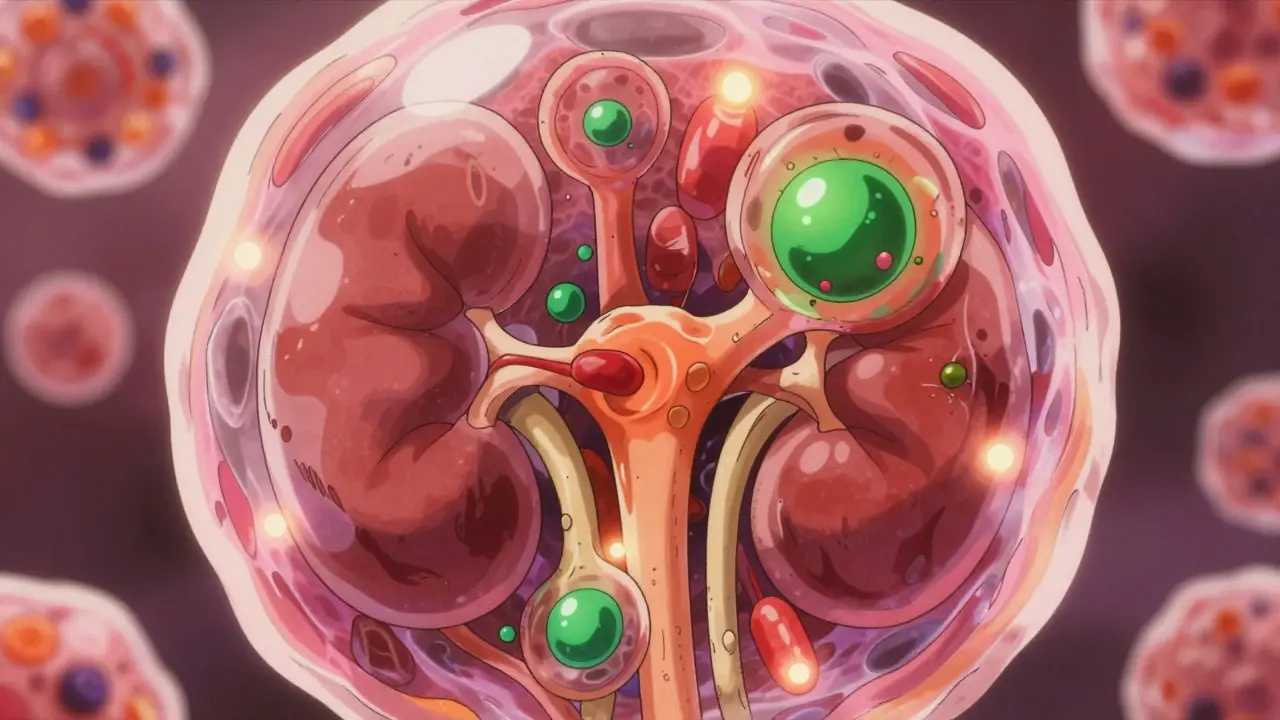
To understand the risk, we need to look at what happens inside the body after an injection. When you receive an aminoglycoside, your kidneys filter the drug from your blood. Most of it passes through harmlessly into the urine. But here’s the catch: about 5% of the dose gets stuck. It accumulates in the epithelial cells lining the proximal tubules, specifically in the S1 and S2 segments. These cells are responsible for reabsorbing nutrients and electrolytes back into the bloodstream.
Once trapped, the drug doesn’t just sit there. It collects in cellular compartments called endosomes and lysosomes. Over time, this accumulation triggers a cascade of cellular stress. The lysosomes swell, their density changes, and they begin to malfunction. This leads to the formation of myeloid bodies-abnormal structures that can spill out into the urine. As the damage progresses, mitochondria (the power plants of the cell) and the endoplasmic reticulum suffer, eventually leading to cell death or dysfunction. This process impairs the kidney's ability to filter blood effectively, causing toxins like creatinine to build up in the body.
| Antibiotic | Nephrotoxic Potential | Primary Use Case | Monitoring Frequency |
|---|---|---|---|
| Gentamicin | High | Sepsis, complicated UTIs | Every 48-72 hours |
| Tobramycin | Moderate-High | Pseudomonas infections | Every 48-72 hours |
| Amikacin | Moderate | Multidrug-resistant organisms | Every 48-72 hours |
Early Warning Signs and Biomarkers
Waiting for a spike in serum creatinine is like waiting for the smoke alarm to go off before checking the kitchen fire-it’s too late. Creatinine is a lagging indicator. By the time it rises by 0.5 mg/dL or more than 50% above baseline, significant cellular damage has already occurred. Fortunately, earlier biomarkers exist.
In the first few days of treatment, look for subtle changes in urine composition. One of the earliest signs is the loss of electrolytes. You might see increased excretion of sodium, potassium, magnesium, and calcium in the urine. Hypomagnesemia (low magnesium) is particularly common and can cause muscle cramps or irregular heartbeats. Another red flag is proteinuria, specifically the presence of low-molecular-weight proteins like beta-2-microglobulin or alpha-2-macroglobulin. Healthy kidneys don’t let these small proteins pass into the urine; when they do, it signals that the proximal tubule cells are injured.
Enzymes such as N-acetylglucosaminidase (NAG) and alanylaminopeptidase also leak into the urine during early damage. While not all hospitals test for these routinely, asking your care team about them can provide an extra layer of safety. If you notice swelling in your legs, sudden weight gain from fluid retention, or unexplained fatigue, report these symptoms immediately. They may indicate that your kidneys are retaining fluid due to impaired function.
Risk Factors That Increase Danger
Not everyone who takes aminoglycosides will develop kidney damage. Several factors make some patients more vulnerable than others. Knowing your risk profile helps healthcare providers tailor the dosage and monitoring schedule.
- Pre-existing Kidney Disease: If your estimated glomerular filtration rate (eGFR) is below 60 mL/min/1.73m², your risk increases by 3.2-fold. Damaged kidneys have less reserve to handle the toxic load.
- Advanced Age: Patients over 65 years old face higher risks due to natural declines in kidney function and reduced muscle mass, which can mask rising creatinine levels.
- Concomitant Medications: Taking other nephrotoxic drugs simultaneously is dangerous. Vancomycin, for example, increases the risk of kidney injury by 2.7-fold when combined with aminoglycosides. Other culprits include certain diuretics and nonsteroidal anti-inflammatory drugs (NSAIDs).
- Volume Depletion: Being dehydrated concentrates the drug in the kidneys, increasing toxicity. Ensuring adequate hydration is a simple but vital protective measure.
- Prolonged Therapy: The longer you stay on the drug, the higher the risk. Most guidelines recommend limiting treatment to 7 days unless absolutely necessary.
Dosing Strategies to Minimize Harm
How the drug is administered matters just as much as the drug itself. Research shows that once-daily dosing (extended-interval dosing) is safer than splitting the same total daily dose into two or three smaller doses. Why? Because aminoglycosides are cleared from the blood relatively quickly, but they linger in kidney tissue. With once-daily dosing, the concentration in the blood spikes high enough to kill bacteria effectively, then drops low enough to give the kidney cells a "rest period" where they aren't constantly exposed to new drug molecules. This allows the cells to recover slightly between doses.
Timing also plays a surprising role. Some studies suggest that administering aminoglycosides around 1:30 p.m. results in the lowest incidence of nephrotoxicity, possibly due to circadian rhythms affecting kidney blood flow and cellular repair mechanisms. While this precise timing isn't standard practice everywhere, it highlights the importance of consistent scheduling.
Therapeutic Drug Monitoring (TDM) is essential. Doctors should check trough levels-the amount of drug left in your blood just before the next dose. For gentamicin, keeping trough levels below 1 μg/mL is crucial. High troughs mean the drug isn't being cleared properly, signaling potential accumulation and increased toxicity risk. Peak levels are also monitored to ensure the dose is high enough to be effective against the bacteria.

Recovery and Long-Term Outlook
If kidney injury occurs, does it mean permanent damage? Not necessarily. The kidneys have a remarkable ability to heal. In most cases, recovery begins 3 to 5 days after stopping the aminoglycoside. Complete functional recovery typically takes 1 to 3 weeks. A large study at Mayo Clinic involving over 1,200 patients found that 82% experienced partial or complete recovery within 30 days of discontinuing therapy.
However, "recovery" doesn't always mean returning to exactly where you started. Some patients experience a permanent reduction in their baseline kidney function. This is especially true if the initial injury was severe or if the patient had pre-existing conditions. Animal studies show that even after apparent recovery, the regenerating tubular cells may be less differentiated, making them potentially more susceptible to future insults. Therefore, preserving kidney health post-treatment is vital. Avoiding NSAIDs, staying hydrated, and managing blood pressure and diabetes can help protect your remaining kidney function.
Future Directions and Protective Agents
Science hasn't stopped looking for ways to neutralize this toxicity. One promising candidate is polyaspartic acid. In laboratory studies, this compound prevents aminoglycosides from binding to kidney cell membranes. It acts like a shield, blocking the drug from entering the lysosomes where it causes the most damage. While no pharmacological protectant is currently approved for routine clinical use, phase II trials are underway for modified versions of these compounds. Until then, the best protection remains careful dosing, rigorous monitoring, and awareness of the risks.
How long does it take for aminoglycoside kidney damage to appear?
Kidney damage typically manifests after 5 to 7 days of continuous therapy. Early biomarkers like electrolyte imbalances may appear sooner, but significant rises in serum creatinine usually occur in the second week of treatment.
Can you reverse aminoglycoside-induced kidney failure?
In most cases, yes. Recovery usually begins within 3-5 days of stopping the drug, with full functional recovery taking 1-3 weeks. However, some patients may retain a slight, permanent reduction in kidney function.
Which aminoglycoside is least likely to damage kidneys?
Among the commonly used agents, amikacin generally demonstrates lower nephrotoxic potential compared to gentamicin at clinically equivalent doses. Tobramycin falls somewhere in between. However, all aminoglycosides carry risk.
What are the early signs of kidney damage from antibiotics?
Early signs include low magnesium levels (hypomagnesemia), increased protein in the urine (proteinuria), and elevated levels of specific enzymes like NAG. Patients may also experience fatigue, mild swelling, or decreased appetite before creatinine levels rise significantly.
Is once-daily dosing safer for the kidneys?
Yes. Clinical evidence supports once-daily dosing over multiple daily doses because it reduces the cumulative exposure of kidney cells to the drug, allowing for periods of clearance and reducing the risk of accumulation and toxicity.