
Crossover Trial Design: How Bioequivalence Studies Are Structured
 Jan, 18 2026
When a generic drug company wants to prove their version of a medication works just like the brand-name version, they don’t just guess. They run a crossover trial design. This isn’t just a common method-it’s the gold standard. More than 89% of all bioequivalence studies approved by the FDA in the last two years used this approach. Why? Because it cuts out the noise. Instead of comparing one group of people to another, each person becomes their own control. That means fewer participants, less cost, and more reliable results.
How a Crossover Trial Works
Imagine you’re testing two versions of the same pill: the original (reference) and the generic (test). In a crossover trial, every participant gets both. But not at the same time. They take one first, wait, then take the other. Half the group gets the generic first, then the brand. The other half gets the brand first, then the generic. This is called a 2×2 design-two treatments, two sequences (AB and BA). The key? The washout period. After finishing the first treatment, participants wait until the drug is completely gone from their system. That’s usually five half-lives. For a drug like warfarin, which clears in about 40 hours, that’s roughly 8-10 days. For slower drugs, like some antidepressants, it could be weeks. If the washout isn’t long enough, leftover drug from the first period can mess up the second. That’s called a carryover effect-and it’s one of the most common reasons studies get rejected by regulators.Why This Design Beats Parallel Studies
In a parallel study, you’d need two separate groups: one gets the generic, the other gets the brand. But people vary. One group might be older, heavier, or metabolize drugs faster. Those differences can hide whether the drugs are truly equivalent. Crossover studies fix that. Since each person takes both drugs, their individual biology cancels out. It’s like comparing your own running times on two different pairs of shoes, instead of comparing your time to someone else’s. This cuts the number of people needed by up to 80%. A study that would need 72 people in a parallel design might only need 24 in a crossover. That’s not just efficiency-it’s money. One clinical trial manager saved $287,000 and eight weeks by switching from parallel to crossover for a generic warfarin study. For companies making hundreds of generics, that adds up fast.What Happens with Highly Variable Drugs?
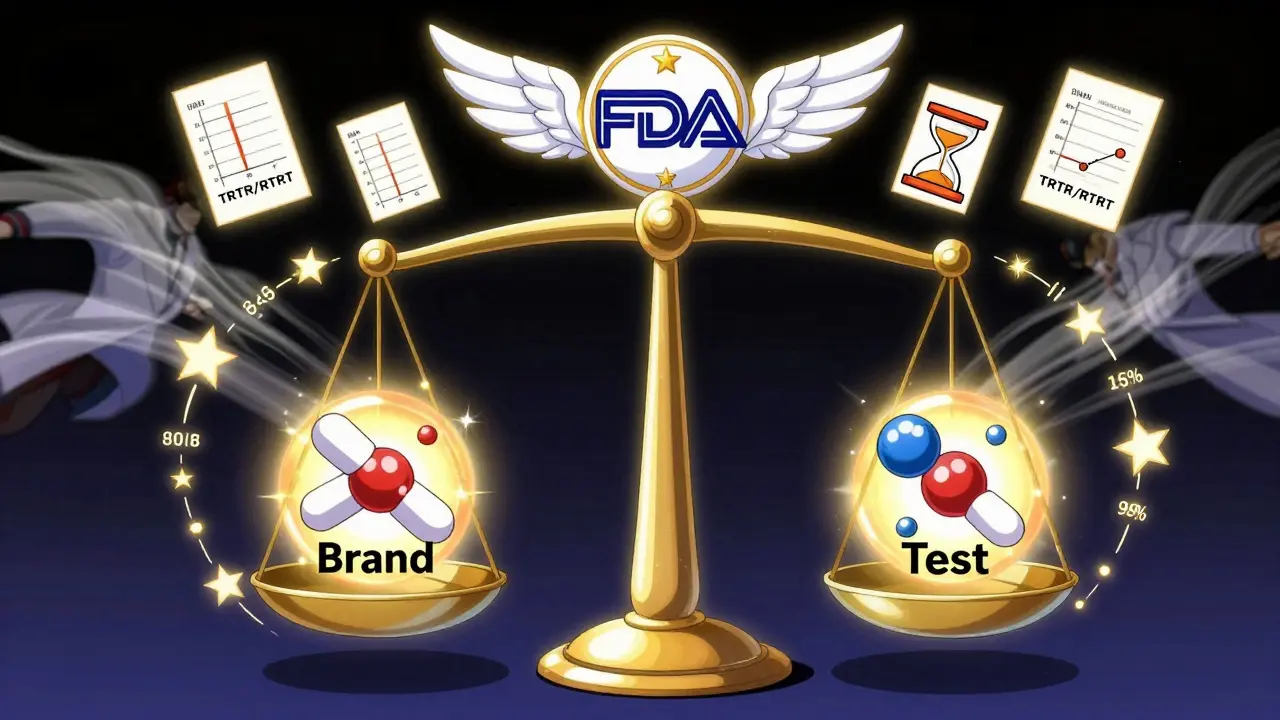
Not all drugs play nice. Some, like warfarin or certain epilepsy meds, show huge differences in how they’re absorbed from person to person. Their intra-subject coefficient of variation (CV) can be over 30%. For those, the standard 2×2 design doesn’t give enough data. The confidence interval might still fall outside the 80-125% range-even if the drugs are actually equivalent. That’s where replicate designs come in. Instead of two periods, you use four. The most common are:- Partial replicate (TRR/RTR): Test twice, reference once (or vice versa)
- Full replicate (TRTR/RTRT): Both test and reference given twice

Statistical Analysis: What Happens Behind the Scenes
It’s not enough to just give people pills and measure blood levels. The data needs careful modeling. Regulators require linear mixed-effects models using software like SAS or R. The model checks for three things:- Treatment effect: Is the generic different from the brand?
- Period effect: Did something change between first and second dosing? (e.g., diet, season, stress)
- Sequence effect: Did the order matter? (e.g., did people respond differently because they got the brand first?)
Real-World Pitfalls and How to Avoid Them
It sounds simple. But mistakes happen. In 2018, about 15% of failed bioequivalence submissions were due to poor washout design. One statistician on ResearchGate lost $195,000 and six months because they underestimated the half-life of their drug. The residual concentration skewed the second period. They had to restart with a four-period replicate design. Other common errors:- Missing data: If someone drops out after the first period, their data can’t be used. Crossover relies on paired comparisons. One data point ruins the pair.
- Improper randomization: Participants must be randomized to sequences (AB or BA), not just assigned to drugs.
- Ignoring period effects: If the study runs from winter to summer, seasonal changes in metabolism can affect results.
What’s Next for Crossover Designs?
The field is evolving. Adaptive designs are gaining ground. These let researchers adjust sample size mid-study based on early data. In 2022, 23% of FDA submissions included adaptive elements-up from 8% in 2018. That means fewer studies fail from underpowering. For narrow therapeutic index drugs (like lithium or digoxin), the FDA is now allowing 3-period replicate designs (TTR/RRT/TRR). These give more data without doubling the number of dosing periods. And while digital health tech-like wearable sensors that track drug levels continuously-could one day eliminate the need for washouts, that’s still years away. For now, the crossover design remains the backbone of bioequivalence testing. Experts predict it will stay dominant through at least 2035.When Crossover Doesn’t Work
There are exceptions. If a drug has a half-life longer than two weeks-like some long-acting injectables or certain cancer drugs-the washout period becomes impractical. You can’t ask someone to wait six months between doses. In those cases, parallel designs are required. Also, for conditions where the drug’s effect is permanent (like a vaccine or surgery), crossover doesn’t make sense. You can’t give someone a vaccine twice and expect the same immune response. But for the vast majority of oral, short-acting medications? Crossover is the smart, efficient, and regulatory-approved way to go.Why is a crossover design preferred over a parallel design in bioequivalence studies?
Crossover designs are preferred because each participant serves as their own control, eliminating variability between individuals. This reduces the number of participants needed by up to six times compared to parallel designs when between-subject variation is high. It also increases statistical power, making it easier to detect small differences between the test and reference products. Regulatory agencies like the FDA and EMA recommend this design for most bioequivalence studies because it’s more efficient and reliable.
What is a washout period, and why is it important?
A washout period is the time between two treatment phases in a crossover study, during which participants receive no drug. It’s critical to ensure the first drug is completely eliminated from the body before starting the second treatment. Typically, it’s set at five half-lives of the drug. If the washout is too short, leftover drug can carry over and distort results from the second period, leading to false conclusions and regulatory rejection.
What is a replicate crossover design, and when is it used?
A replicate crossover design gives each participant multiple doses of both the test and reference products-usually in a four-period setup (e.g., TRTR/RTRT or TRR/RTR). It’s used for highly variable drugs (intra-subject CV >30%) where standard two-period designs can’t reliably estimate within-subject variability. This design allows regulators to use reference-scaled average bioequivalence (RSABE), which adjusts the acceptance range based on how variable the reference drug is, making it fairer for drugs with natural fluctuations in absorption.
What are the regulatory bioequivalence limits for AUC and Cmax?
For most drugs, the 90% confidence interval for the ratio of geometric means (test/reference) must fall within 80.00% to 125.00% for both AUC (area under the curve, representing total exposure) and Cmax (maximum concentration). For highly variable drugs using RSABE, these limits can be widened to 75.00% to 133.33%, depending on the reference drug’s variability. These limits are set by the FDA and EMA to ensure the generic performs similarly to the brand.
Can a crossover study be used for all types of drugs?
No. Crossover designs are unsuitable for drugs with very long half-lives (over two weeks), where the washout period would be too long to be practical. They’re also not used for drugs with irreversible effects, such as vaccines or surgical treatments. In these cases, parallel designs are required. Additionally, if a drug’s effect persists beyond the washout, carryover effects can invalidate results, making crossover inappropriate.
For generic drug manufacturers, mastering crossover trial design isn’t optional-it’s essential. The difference between approval and rejection often comes down to how well the washout was planned, how the data was modeled, and whether the right design was chosen for the drug’s variability. Those who get it right save time, money, and get life-saving generics to market faster.
Malikah Rajap
January 19, 2026 AT 08:03Okay, but have you ever tried to explain this to someone who just wants their blood pressure meds to work without going broke? I mean, I get the math, but real people? They don’t care about CVs or geometric means-they care if their pills don’t make them dizzy or give them a headache. And honestly? If the generic works, let them take it. No need to over-engineer the whole thing.
Aman Kumar
January 20, 2026 AT 09:04What’s laughable is how people still treat this like some sacred algorithm. The FDA’s 80-125% rule is a statistical fiction masquerading as science. You’re comparing AUC and Cmax like they’re the only metrics that matter-what about tissue penetration? Metabolite profiles? Pharmacodynamic endpoints? You’re reducing complex pharmacokinetics to a spreadsheet. This isn’t bioequivalence-it’s regulatory theater. And don’t even get me started on RSABE-it’s just a backdoor for lazy manufacturers to cut corners under the guise of ‘flexibility.’
Jake Rudin
January 21, 2026 AT 07:36There’s something deeply poetic about the crossover design, isn’t there? Each person becomes their own control-not just statistically, but existentially. We’re all trying to measure equivalence in a world built on comparison. The washout period? That’s not just a waiting game-it’s a meditation on impermanence. The drug leaves, the body resets, and then you try again. It’s a quiet metaphor for renewal. And yet, we reduce it to p-values and confidence intervals. We forget the human rhythm beneath the data.
Astha Jain
January 22, 2026 AT 08:11lol so like, the whole point of this is so generic pharma can save cash? i mean, i get it, but why do they make it sound so fancy? its just like, wait a bit, take the other pill, do the math. why do we need 4-period designs and SAS models? can’t we just… give people the pill and see if they live? 🤷♀️
Valerie DeLoach
January 22, 2026 AT 12:57I appreciate how much thought goes into this, but I also think we need to talk about accessibility. A lot of these studies are done in wealthy countries with access to clinics, monitoring, and consistent care. What about people in low-resource settings where even getting a single dose of a drug is a challenge? The elegance of crossover design doesn’t help someone who can’t afford to miss work for 10 days between dosing periods. We need innovation that serves everyone-not just the statistically optimal.
Tracy Howard
January 22, 2026 AT 22:38Ugh, Americans act like they invented bioequivalence. We’ve been doing this properly in Europe since the 90s. The FDA’s obsession with 80-125% is outdated. The EMA’s RSABE framework is the real deal-flexible, science-based, and not stuck in the Stone Age. And don’t even get me started on how you Americans think ‘washout period’ is a technical term. We’ve been calculating half-lives in our sleep since before your FDA was a twinkle in some bureaucrat’s eye. Stop acting like you’re the gold standard-you’re just the loudest.
Lydia H.
January 24, 2026 AT 03:23Love this breakdown. Honestly, I didn’t realize how much thought went into something so invisible. Like, I just pop a pill and assume it’s the same. But now I see it’s this whole ballet of timing, math, and human biology. Kinda beautiful, actually. Also, props to the stat nerds who make sure we don’t get poisoned by leftover drug. You’re the unsung heroes of modern medicine.
Phil Hillson
January 25, 2026 AT 20:41So basically this whole thing is just a way to make generic companies look smart while the rest of us pay for it? I mean, I get the science, but why does it feel like we’re paying for a 100-page manual to sell us a $3 pill? Can we just make the damn thing work and move on? I’m tired of reading about half-lives and confidence intervals. My stomach just wants to stop hurting.
Josh Kenna
January 27, 2026 AT 03:55Wait so if someone drops out after the first period, you just toss their whole data? That seems so wasteful. I mean, if they took the first pill and didn’t have side effects, isn’t that still useful? Why can’t you just use partial data? I know it messes with the stats but… like, isn’t some data better than none? Also, I typo’d ‘washout’ as ‘wasout’ twice. Sorry.
Erwin Kodiat
January 27, 2026 AT 14:15This is why I love science-real, gritty, practical science. Not the flashy kind with lasers and AI. This is the quiet, boring, meticulous work that actually saves lives. Someone spent months calculating half-lives so your grandma can afford her blood thinner. That’s worth celebrating. Keep doing the hard stuff. The world needs more of this.
Jacob Hill
January 29, 2026 AT 13:23Just wanted to say: the 2×2 design is elegant, but I’ve seen too many studies where the washout was ‘estimated’ from a paper that was cited wrong. One study used a 14-day washout for a drug with a 72-hour half-life. That’s not conservative-that’s just lazy. And then they wonder why the FDA rejected it. Document your half-life sources. Please. For the love of all that is statistically valid.