
Generic combination products: When multiple generics equal one brand
 Jan, 17 2026
Think you can just swap a branded drug for its generic version and call it a day? That works for most pills. But when a drug is tied to a device-like an auto-injector, inhaler, or prefilled syringe-it’s not that simple. You can’t just buy a generic epinephrine and plug it into a branded EpiPen and expect the same result. That’s the reality of generic combination products: when two or more generic parts must come together to match a single branded product, and the system isn’t built to handle it.
What exactly is a combination product?
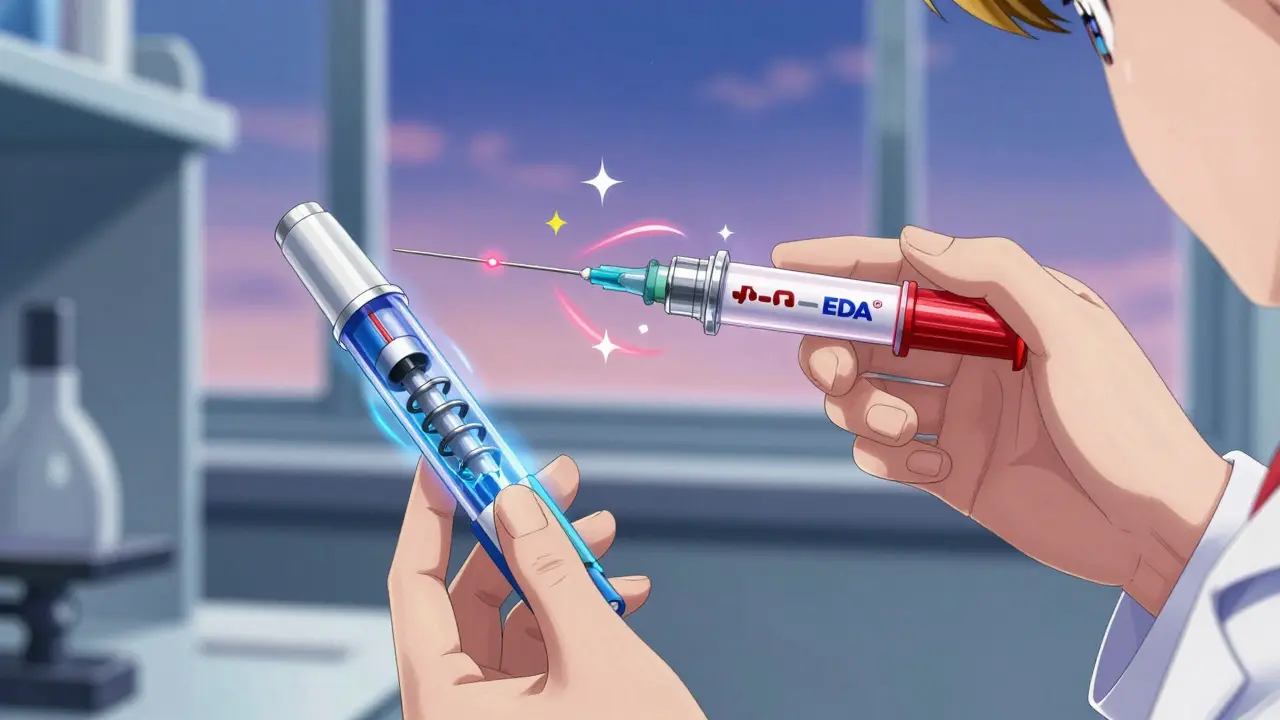
A combination product isn’t just a drug and a device sitting in the same box. It’s a product where the drug and device are designed to work as one. The FDA defines it clearly: if the components are physically combined, packaged together, or labeled specifically for use together, they’re a combination product. Examples? Prefilled insulin pens, auto-injectors like EpiPen, inhalers with built-in dose counters, and even wound dressings soaked in antibiotics. Each part matters. The drug delivers the treatment. The device ensures it gets into the body correctly, safely, and consistently.Here’s the catch: when a brand like EpiPen gets generic competition, the generic version must replicate both the drug and the device. You can’t substitute just the drug. You need the exact same auto-injector mechanism. Why? Because the device controls how much drug is delivered, how fast, and how reliably. A different spring, a different needle length, or even a slightly different button feel can change how a patient uses it-and that can be life-threatening.
Why are generic combination products so hard to make?
Creating a generic version of a simple pill? Easy. You match the active ingredient, run a few tests, and file a quick application. But for a drug-device combo? It’s a different world. The FDA requires manufacturers to prove their generic version works just like the brand-not just in the lab, but in real hands.That means human factors testing. Real people-patients, caregivers, nurses-must use the generic device exactly as they’d use the brand. They’re watched. Their mistakes are logged. Their grip strength, dexterity, and confusion are measured. The FDA demands a six-phase usability study to prove the generic isn’t just similar-it’s interchangeable. If even one user fumbles the injection because the button clicks differently, the application gets rejected.
And the cost? It’s brutal. Developing a generic combination product adds $2.1 million to $3.7 million to the price tag. It takes 9 to 15 extra months. That’s why only 17 companies in the U.S. have successfully launched generic combination products, compared to over 120 making plain generic pills. Most small manufacturers just walk away.
The substitution problem: Why pharmacies can’t just swap them
Pharmacists are stuck in the middle. Under most state laws, they can substitute a generic drug for a brand if it’s deemed therapeutically equivalent. But that rule doesn’t cover combination products. A generic epinephrine isn’t interchangeable with a branded EpiPen unless the generic auto-injector is also approved-and often, it isn’t.Surveys show 68% of community pharmacists have run into substitution confusion. Patients show up with a prescription for EpiPen, get handed a generic epinephrine vial and syringe, and are told, “Just use this.” That’s not safe. That’s not legal. But it happens. One Reddit user shared a story where a pharmacist substituted a generic epinephrine without the device. The patient didn’t know how to draw up the dose. They waited 20 minutes in the pharmacy while the pharmacist called the doctor. That’s 20 minutes where someone with a severe allergy is vulnerable.
Healthcare providers report treatment delays of over three business days per substitution mix-up. That’s not just inconvenience. That’s risk. In 2023, patient advocacy groups documented 217 cases where people couldn’t access a therapeutic equivalent because the generic device didn’t exist. And that number is rising-29% higher than the year before.
Market reality: Few generics, higher prices
The global market for drug-device combination products is worth $138.7 billion-and growing fast. But only 12% of that market is generic. The rest? Branded. Why? Because the barriers to entry are so high, only big players can afford to play.Compare that to regular generic drugs: over 90% of prescriptions are filled with generics. For combination products? Only 38% have more than one generic version approved. That lack of competition keeps prices high. Patients pay 37% more out-of-pocket for these products than for standard generics. An EpiPen generic might cost $150. The brand? $300. But if the generic auto-injector isn’t approved? You pay $300 anyway.
Some areas are doing better. Generic inhalers have about 38% market share. Auto-injectors? Just 19%. That gap isn’t random. Inhalers are easier to replicate. Auto-injectors? Tiny springs, precise triggers, complex safety features. Replicating those takes years.
What’s changing? New rules, new hope
The FDA knows this isn’t working. In April 2024, they released new guidance specifically for generic combination products. It’s clearer. It’s more detailed. It tells manufacturers exactly what data they need for device comparisons.They’ve also hired 32 new reviewers just for these products-a 45% increase since 2022. And in June 2024, FDA Commissioner Robert Califf launched “Complex Generic Initiative 2.0,” with a goal to cut approval times by 30% by 2026. That’s huge.
States are stepping in too. California and Massachusetts passed laws requiring pharmacists to be able to substitute generic combination products when they’re approved. Other states are following. This isn’t just about cost-it’s about access. If a patient can’t get their EpiPen because the generic device isn’t approved, they’re not getting treatment at all.

What does this mean for patients?
If you use a combination product-whether it’s an insulin pen, an asthma inhaler, or an epinephrine auto-injector-here’s what you need to know:- Don’t assume your pharmacist can swap the brand for a generic. Ask first.
- If you’re given a generic drug without the matching device, ask why. It might not be safe.
- Check the box. The device name should be on the label. If it’s different from your prescription, speak up.
- Keep your current device on hand until you’re sure the generic version is approved and available.
The goal isn’t to stop generics. It’s to make sure they work. A generic combination product isn’t just a cheaper version. It’s a whole new product that has to be proven safe, reliable, and interchangeable. And until that proof exists, the brand stays in charge.
What’s next?
The tide is turning. More generics will come. But they’ll come slowly. And they’ll come with paperwork, testing, and regulation. The system isn’t broken-it’s just outdated. It was built for pills, not devices. Now it’s catching up.For now, patients and providers need to be more careful. Don’t assume substitution is automatic. Ask questions. Demand clarity. And remember: when a drug and a device are meant to work as one, you can’t split them without risking the outcome.
Can I use a generic drug with a branded device?
No, not unless the FDA has specifically approved that combination as interchangeable. Even if the drug is generic, the device is part of the product. Using a branded device with a generic drug may not deliver the correct dose or may not be safe. Always check with your pharmacist or prescriber before switching components.
Why are generic combination products so expensive?
Because developing them is extremely complex. Manufacturers must test not just the drug, but how the device works with it-through human trials, usability studies, and device performance tests. These studies cost millions and take years. Few companies can afford it, so competition stays low, and prices stay high.
Are there any generic combination products available right now?
Yes, but they’re rare. Some generic inhalers, insulin pens, and epinephrine auto-injectors are approved. But for every one that’s available, there are several branded products with no generic alternative. Check the FDA’s Orange Book or ask your pharmacist for the latest list of approved generics.
What should I do if my pharmacy gives me the wrong part of a combination product?
Don’t use it. Call your prescriber immediately. If you’re using a life-saving product like an epinephrine injector, using mismatched components could be dangerous. Pharmacists are required to verify the full combination product matches the prescription. If they don’t, report it to your state pharmacy board.
Will generic combination products become more common soon?
Yes, but slowly. The FDA is making changes to speed up approvals, and more states are updating substitution laws. Analysts predict generic market share could rise from 12% to 35% by 2027. But because of the technical hurdles, it won’t happen overnight. Patience and vigilance are still needed.
Christi Steinbeck
January 17, 2026 AT 23:12This is such a critical issue that no one talks about. I have a kid with severe allergies, and we got handed a generic epinephrine vial last year because the pharmacist thought it was ‘the same thing.’ We almost lost him. The device isn’t just packaging-it’s the difference between life and a 20-minute panic in a pharmacy aisle. Please, everyone, ask before you use anything that doesn’t match your prescription exactly.
Jacob Hill
January 17, 2026 AT 23:17Okay, so-let me get this straight: if the auto-injector’s spring tension is off by 0.5%, or the button click is a millisecond slower, the FDA says it’s a no-go? That’s insane. And yet, somehow, we expect a $300 EpiPen to be ‘safe’ because it’s branded? The system is broken. Why does a tiny mechanical component hold up life-saving medicine like it’s a patent lawsuit?!
Jackson Doughart
January 18, 2026 AT 06:30The regulatory framework for combination products was designed in an era of tablets and syringes. Today, we have smart inhalers with Bluetooth connectivity, insulin pens with dose-tracking chips, and auto-injectors calibrated to biomechanical feedback. Yet, the FDA still treats them as if they were simple drug-device pairings. The gap between technological reality and regulatory capacity is widening-and patients are paying the price in delayed access, confusion, and, tragically, preventable harm.
Aman Kumar
January 20, 2026 AT 04:54Of course, the FDA is slow. The pharmaceutical-industrial complex has been lobbying for decades to keep generics out of combination products. Why? Because they make 80% of their profits from devices, not drugs. The ‘human factors testing’ is just a smoke screen. Real innovation is stifled by corporate greed disguised as safety. The real solution? Break up the big pharma monopolies and let open-source device designs compete. The people don’t need branded plastic-just functional, affordable tech.
Lydia H.
January 21, 2026 AT 11:38It’s funny how we treat pills like candy but treat a device like a nuclear launch code. If a generic pill can be swapped without a second thought, why can’t a generic injector? We’re treating patients like lab rats while the system chugs along like a 1998 dial-up modem. Maybe we need to stop pretending devices are ‘too complex’ and just… let people try them? Most of us are smarter than we’re given credit for.
Erwin Kodiat
January 22, 2026 AT 02:56My dad uses an insulin pen. He’s 72. He doesn’t care if it’s branded or generic-he cares if it works, and if he can afford it. Last month, he got handed a generic that didn’t match his old pen’s click. He didn’t know if he got the full dose. He cried. Not because he was scared of the shot-but because he felt like the system had forgotten him. This isn’t about regulation. It’s about dignity.
Valerie DeLoach
January 23, 2026 AT 09:54Let’s be precise: therapeutic equivalence applies only when the entire product-drug + device-is proven interchangeable. The FDA’s Orange Book clearly delineates which combinations are approved for substitution. Pharmacists who ignore this are not just making mistakes-they’re violating federal labeling laws. Patients must be educated to demand the full product, not just the drug component. Clarity, not convenience, saves lives.
Malikah Rajap
January 24, 2026 AT 18:09Wait-so you’re saying if I buy a generic epinephrine, I can’t just use my old EpiPen? But mine works fine! Why do I need a whole new device? It’s like buying a new battery for your phone just because the charger changed colors. This feels like corporate nonsense. Who’s really benefiting here? The FDA? Or the guys in suits who own the patents?
sujit paul
January 26, 2026 AT 17:19There is a deeper, more sinister layer: the FDA’s approval delays are not merely bureaucratic-they are orchestrated by the American Medical Association and the Pharmaceutical Research and Manufacturers of America (PhRMA) to maintain monopolistic pricing structures. The so-called ‘human factors testing’ is a legal fiction designed to delay generic entry. The truth? The device components are reverse-engineered with precision. The real barrier is not engineering-it is lobbying.
Tracy Howard
January 28, 2026 AT 12:58Canada’s been doing this right for years. We don’t need 15 phases of human testing to confirm that a spring works. If the drug concentration matches, and the delivery mechanism is mechanically similar, it’s interchangeable. The U.S. is stuck in a self-inflicted regulatory purgatory. We pay 3x more for the same medicine because you guys can’t make a decision without a 200-page white paper. Pathetic.
Astha Jain
January 29, 2026 AT 23:11lol why is this even a thing? just make the generic device and be done with it. people are dying because some engineer can’t copy a button. it’s not rocket science. also why do we still use plastic injectors? can we get metal ones? they’re cheaper and last forever.
Phil Hillson
January 31, 2026 AT 06:28THIS IS WHY WE CAN’T HAVE NICE THINGS. Everyone wants cheap drugs but no one wants to deal with the fact that medicine isn’t a Netflix subscription. You can’t just swap parts like Lego. The system is broken because we treat healthcare like Amazon Prime. And now people are dying because someone thought ‘it’s basically the same.’ Wake up. This isn’t a glitch-it’s a feature of capitalism.