
Generic Drug Quality Issues: Manufacturing Plant Problems Explained
 Jan, 11 2026
When you pick up a generic pill at the pharmacy, you expect it to work just like the brand-name version. But what if it doesn’t? Behind every generic drug is a manufacturing plant-often thousands of miles away-where small mistakes can lead to big dangers. Between 2018 and 2022, over 3,900 drug products were recalled in the U.S. alone because of quality issues tied to manufacturing flaws. These aren’t rare glitches. They’re systemic problems rooted in how generic drugs are made, inspected, and regulated globally.
What Exactly Goes Wrong in Generic Drug Manufacturing?
Generic drugs aren’t copies. They’re supposed to be identical in active ingredient, strength, dosage form, and performance. But when manufacturing goes off-track, even tiny differences can matter. The biggest culprits? Failures in Current Good Manufacturing Practices (cGMP).One major issue is impurities. In 2018, the FDA found N-nitrosodimethylamine (NDMA)-a probable carcinogen-in valsartan, a blood pressure medication. The contamination came from a chemical reaction during manufacturing at a plant in China. That single error led to 28 recalls across 22 countries and affected over 2 million patients. Similar problems popped up in other drugs like ranitidine and metformin. These aren’t random accidents. They’re signs of deeper problems in process control.
Other common failures include:
- **Inadequate analytical methods**: 18.7% of FDA inspection observations in 2022 pointed to labs using unreliable tests to check drug purity.
- **Poor packaging**: 12.3% of issues involved packaging that didn’t protect the drug from moisture, light, or air-leading to degradation before it even reached patients.
- **Missing stability data**: 15.6% of observations showed manufacturers didn’t test how long the drug stays effective under real-world conditions.
- **Unapproved drug sources**: 9.8% of problems came from using raw materials from suppliers that weren’t properly vetted or documented.
These aren’t just paperwork errors. They directly impact whether a drug works. For drugs with a narrow therapeutic index-like warfarin, lithium, or tacrolimus-small changes in absorption can cause toxicity or treatment failure. In 2022, 37% of complete response letters from the FDA to generic manufacturers were due to bioequivalence concerns with these high-risk drugs.
Why Are Foreign Plants More Likely to Have Problems?
About 80% of the active ingredients in U.S. drugs and 40% of finished pills come from overseas-mostly China and India. That’s not inherently bad. But the system for checking them is broken.The FDA inspects U.S. facilities without warning. In foreign countries, they have to give notice-sometimes months in advance. That gives plants time to clean up, hide documents, or temporarily fix issues. A 2023 study from Ohio State University found that generic drugs made in India were linked to 23.7% more severe side effects than those made in the U.S.
Inspection data shows the gap is real:
- Foreign facilities get 28.6% more FDA Form 483 observations (official notices of violations) than U.S. ones.
- Chinese facilities average 28.6% more violations than U.S. plants.
- Indian facilities average 19.3% more.
And the FDA can’t even see most of them. In 2016, nearly 1,000 foreign facilities exporting drugs to the U.S. had never been inspected. Even today, the agency inspects only about 13% of foreign facilities each year-despite overseeing 73% of finished drug products made abroad.
What Happens When Quality Control Fails?
When a plant cuts corners, the consequences aren’t theoretical. They show up in hospitals, pharmacies, and patient reports.From 2019 to 2022, the FDA’s Adverse Event Reporting System recorded 1,842 reports tied directly to generic drug quality problems. One of the worst cases involved nitroglycerin sublingual tablets made by Impax Laboratories. The tablets didn’t dissolve properly-meaning patients having a heart attack didn’t get the life-saving dose. That single product accounted for 14.3% of all quality-related reports.
Hospital pharmacists aren’t ignoring the problem. A 2022 survey by the American Society of Health-System Pharmacists found that 67.3% had experienced at least one therapeutic failure with a generic drug in the past year. Nearly half of those failures were linked to products made in India.
Patients noticed too. On Drugs.com, generic valsartan made by Zhejiang Huahai Pharmaceutical got a 3.2-star average rating. Users wrote: “Didn’t lower my blood pressure,” “Felt like the brand version didn’t work,” “Woke up with headaches every morning.” The U.S.-made version? 4.1 stars.
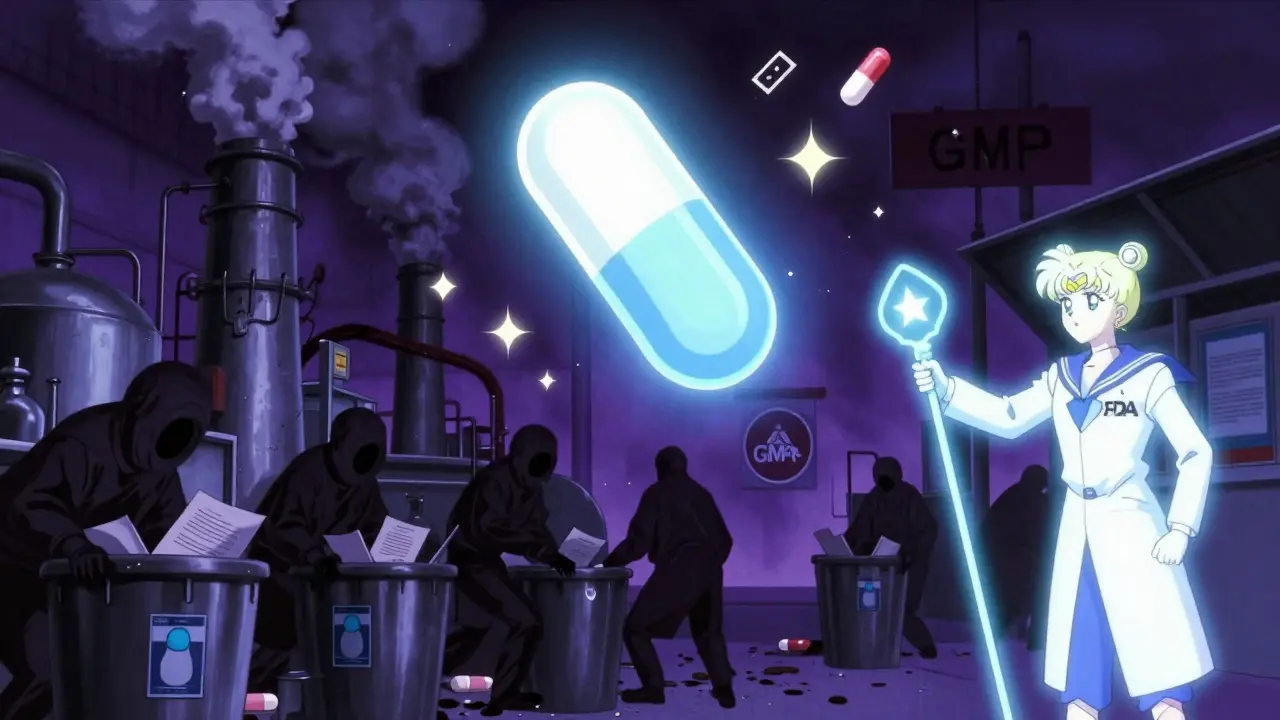
And then there’s the disturbing footage from an FDA inspection at Intas Pharmaceuticals in Gujarat, India, in July 2022. An employee was caught pouring acid into a trash can full of documents related to quality testing. The FDA issued a warning letter. The plant kept making drugs.
Why Is This Still Happening?
It’s not just negligence. It’s economics.The generic drug market is a race to the bottom. Between 2018 and 2022, average prices dropped 18.3% per year. To stay profitable, manufacturers slashed quality budgets by 22.7%. Training, testing, and documentation got cheaper-or disappeared.
Here’s what gets cut:
- **Staff training**: 31.2% of FDA violations cited inadequate training.
- **Data integrity**: 24.8% of issues involved fake or deleted records-like not keeping audit trails or using weak passwords.
- **Corrective actions**: 19.6% of plants didn’t fix problems properly, or didn’t document fixes at all.
Only 23.8% of generic manufacturers have fully adopted Quality by Design (QbD)-a science-based approach that builds quality into the product from day one. The rest rely on old-school testing after production. That’s like checking the brakes after the car crashes.
Regulatory costs are rising too. FDA user fees for generic applications jumped 62.9% from 2018 to 2023. But the agency’s budget hasn’t kept up. In 2022, the FDA tested just 0.02% of imported drug shipments in labs. That’s one out of every 5,000 packages. Everything else? Based on paperwork.

What’s Being Done to Fix It?
There’s some progress-but it’s slow.The FDA issued 147 warning letters for cGMP violations in 2022, up 28.5% from 2021. Most targeted foreign plants. Congress gave the FDA $56.7 million in 2022 to boost foreign inspections, aiming to go from 1,200 to 1,800 per year by 2027.
Europe went further. Since January 2023, the European Medicines Agency (EMA) has conducted unannounced inspections at all foreign facilities supplying the EU. The result? A 41.2% spike in critical findings-because plants couldn’t hide.
The FDA’s 2023-2027 plan says it will prioritize high-risk facilities-especially those making complex generics like inhalers, injectables, or NTI drugs. They’re also requiring 100% more stability data and 75% more bioequivalence studies for these products.
But experts say it’s not enough. Dr. Ameet Nathwani of Sanofi called the current inspection model “fundamentally broken.” Dr. Aaron Kesselheim from Harvard found that 15.2% of generic drugs on the FDA Watch List showed therapeutic inequivalence. For tacrolimus, blood levels varied 28.4% more than the brand version-enough to cause organ rejection in transplant patients.
What Should Patients and Providers Do?
You can’t control where your drugs are made. But you can stay informed.- **Ask your pharmacist**: If you’re on a critical drug like warfarin, thyroid meds, or immunosuppressants, ask if your generic is made in the U.S. or a country with stricter oversight.
- **Monitor effects**: If you switch generics and feel different-worse side effects, less effectiveness-tell your doctor. Don’t assume it’s “in your head.”
- **Check recalls**: Sign up for FDA recall alerts. You can find them at fda.gov/safety/recalls.
- **Report issues**: Use the FDA’s MedWatch program to report adverse events. Every report helps build the case for change.
For prescribers: When possible, choose generics from manufacturers with a clean inspection history. The FDA publishes inspection reports online. Look for facilities with zero Form 483s in the last three years.
The system is flawed. But awareness and action can protect lives. You deserve a pill that works-every time.
Are generic drugs always safe?
Most generic drugs are safe and effective. But not all. Quality issues tied to manufacturing-especially at foreign facilities-have led to recalls, adverse events, and treatment failures. The risk is higher for drugs with narrow therapeutic indexes, like blood thinners or immunosuppressants. Always monitor how you feel after switching generics.
How can I tell where my generic drug was made?
The label doesn’t always say. But the drug’s National Drug Code (NDC) number can help. You can search the NDC on the FDA’s website to find the manufacturer and location. Some pharmacies also track this info. If you’re unsure, ask your pharmacist to check the source.
Why don’t the FDA test every imported drug?
The FDA lacks the resources. In 2022, they tested only 0.02% of imported drug shipments-about one out of every 5,000 packages. Instead, they rely on inspections of manufacturing sites and paperwork from companies. That’s why unannounced inspections and better data integrity are so important.
What’s the difference between cGMP and regular manufacturing standards?
cGMP stands for Current Good Manufacturing Practices. It’s a set of rules enforced by the FDA that require manufacturers to have systems in place to ensure consistent quality, accurate labeling, and contamination control. Regular manufacturing standards might just mean “making a pill.” cGMP means proving every step-from raw materials to final packaging-is controlled, documented, and tested.
Are U.S.-made generics better than foreign ones?
On average, yes. U.S. facilities have fewer FDA violations, and inspections are unannounced. Studies show U.S.-made generics have fewer adverse events. But not all foreign-made drugs are bad-some facilities in India and China follow cGMP strictly. The key is checking the manufacturer’s inspection history, not the country.
What should I do if my generic drug doesn’t seem to work?
Don’t ignore it. Track your symptoms and report them to your doctor. If you recently switched generics, ask if the manufacturer changed. You may need to switch back to the brand or try a different generic. Also, file a report with the FDA’s MedWatch program. Your report helps regulators spot patterns.
Lawrence Jung
January 12, 2026 AT 00:58People act like generics are some kind of scam but the truth is most work fine. The system isn't perfect but it's not a conspiracy either. You want perfect? Pay 10x more for brand names. Simple as that.
Sona Chandra
January 12, 2026 AT 05:16Oh so now we're blaming India again? Funny how the same people who scream about outsourcing when it's jobs suddenly get quiet when it's pills. You think your $200 brand-name heart med is made in Ohio? LOL. Try again.
Alice Elanora Shepherd
January 13, 2026 AT 19:03It's important to note that not all Indian or Chinese manufacturers are problematic-many are FDA-compliant and produce excellent products. The issue lies in inconsistent oversight and economic pressure, not geography. Always check the manufacturer's inspection history on the FDA website-it's publicly available.
Rinky Tandon
January 13, 2026 AT 20:29Let me tell you about the lab in Gujarat I visited last year-the one with the acid-burning documents. They were making metformin that had 37% less active ingredient. Patients were crashing. The FDA knew. They issued a warning. The plant kept shipping. That’s not negligence. That’s corporate murder. And no, I’m not exaggerating.
Lauren Warner
January 14, 2026 AT 13:29Wow. Another fear-mongering op-ed dressed up as journalism. You cite 1,842 adverse events but don’t mention that there are over 4 billion generic prescriptions filled annually. That’s 0.000046% failure rate. You’re scaring people over statistically insignificant noise.
Audu ikhlas
January 15, 2026 AT 18:47America thinks it's the center of the world but our drugs are made by people who can't even spell 'pharmaceutical' right. Meanwhile, we're crying about quality? We can't even fix our own healthcare system. Go cry to your senators. I'm buying my meds from India because they're cheaper and honestly? I haven't died yet.
beth cordell
January 17, 2026 AT 10:22Just switched my generic lisinopril to the U.S.-made version and my headaches are gone 😌 No joke. I thought it was stress. Turns out, my body knew. Always check the NDC code. It’s free intel. 🧠💊
Darryl Perry
January 18, 2026 AT 23:56The FDA inspects 13% of foreign facilities. That’s not oversight. That’s negligence. If you ran a restaurant and only checked 1 in 8 kitchens, you’d be shut down. Why are drugs different?
Daniel Pate
January 20, 2026 AT 19:48If quality is built into the design from day one-Quality by Design-why do 76% of manufacturers still rely on post-production testing? It’s like building a bridge and only checking the bolts after the first car crashes. The system is reactive, not proactive. And that’s the real failure.
Cassie Widders
January 21, 2026 AT 23:23I used to buy the cheapest generic until my mom had a bad reaction to her thyroid med. Now I pay extra for the ones with clean inspection records. It’s not about patriotism. It’s about not risking your life for $2.
Lelia Battle
January 23, 2026 AT 09:02There’s a deeper philosophical question here: if a drug works identically in the body, does it matter where it was made? Or is our fear not of the pill, but of the foreign hand that made it? We demand affordability but recoil at the cost of global supply chains. We want the benefit without the burden.
Amanda Eichstaedt
January 24, 2026 AT 05:58My pharmacist just told me my metformin is from a plant in Hyderabad that got a clean bill of health last year. I asked for the report. She printed it. Took 2 minutes. You don’t need to be a scientist to check this stuff. Just ask. Seriously. Ask.
Windie Wilson
January 26, 2026 AT 03:16So the FDA can’t inspect 87% of foreign plants… but they can fine you $500K for a typo on a label? 😂 We’re punishing grammar but ignoring cancer-causing impurities. Classic.
Ben Kono
January 27, 2026 AT 23:41My dad’s on warfarin. Switched generics last year. INR went from 2.3 to 4.8. He almost bled out. The new maker? India. The old one? U.S. He’s back on the brand now. Don’t gamble with your life. It’s not worth the $15.
Konika Choudhury
January 29, 2026 AT 10:33Stop acting like India is the villain. The U.S. outsourced production to cut costs. Now you're mad the cheap labor didn't follow your rules? Wake up. This isn't a moral failure. It's capitalism. And you're the customer who asked for it cheap.