
How Drinking Water Helps You Lose Weight by Curbing Appetite and Boosting Performance
 Jan, 4 2026
Want to lose weight without cutting out your favorite foods or spending hours at the gym? One of the simplest, cheapest, and most backed-by-science tools you already have is water. It’s not magic. But if you drink it right, it can help you eat less, burn more calories, and feel more energized - all without a single pill or diet plan.
Why Water Makes You Feel Full (Without Eating)
Ever finish a meal and still feel hungry? That might not be your stomach asking for more food - it might just be thirsty. Your body often confuses thirst for hunger. And when you drink water before eating, you’re not just quenching thirst - you’re tricking your brain into thinking you’re already full. A study from Johns Hopkins found that people who drank two 8-ounce glasses of water (about 500ml) right before a meal ate 22% less food. That’s roughly 111 fewer calories per meal. Over time, that adds up. Do that three times a day, and you’re cutting out nearly 330 calories daily - which could mean losing a pound every 10 days, just from drinking water. The science behind this is simple: when water fills your stomach, it stretches the walls. That sends a signal to your brain saying, “Enough.” Within 15 to 20 minutes, your appetite drops. You don’t need to feel bloated. You just need to drink before you eat.Water Burns Calories - Yes, Really
Here’s where most people get surprised: water doesn’t just fill you up. It actually makes your body burn more calories. This is called water-induced thermogenesis. When you drink a glass of cold water, your body has to warm it up to your core temperature (37°C). That takes energy. A study in the Journal of Clinical Endocrinology & Metabolism showed that drinking 500ml of water boosts your metabolism by 24-30% for about 40 minutes. That’s about 23 extra calories burned per liter. Sounds small? Multiply that by four or five liters a day, and you’re burning an extra 100-120 calories - roughly the same as a 15-minute walk. It’s not a magic fat-burning switch. But in the long run, it’s one of the few weight loss tools that works even when you’re sitting still.Drink Before Meals - The 1.5L Rule
Not all water drinking is created equal. If you sip water all day, you might not see results. But if you drink it right before meals, the effect is stronger. A 2024 review in JAMA Network Open analyzed multiple studies and found that people who drank 1.5 liters of water daily - split into three 500ml portions - 30 minutes before breakfast, lunch, and dinner lost 44% to 100% more weight than those who didn’t. In one study, overweight women lost an extra 1.85kg in just eight weeks. Another study with middle-aged adults showed they lost 2kg more than the control group - and almost all of that came from eating less. Timing matters. Drinking water 30 minutes before meals gives your stomach time to stretch. Drinking right before you bite into your food gives you the full appetite-suppressing effect. Waiting until after the meal? That’s too late.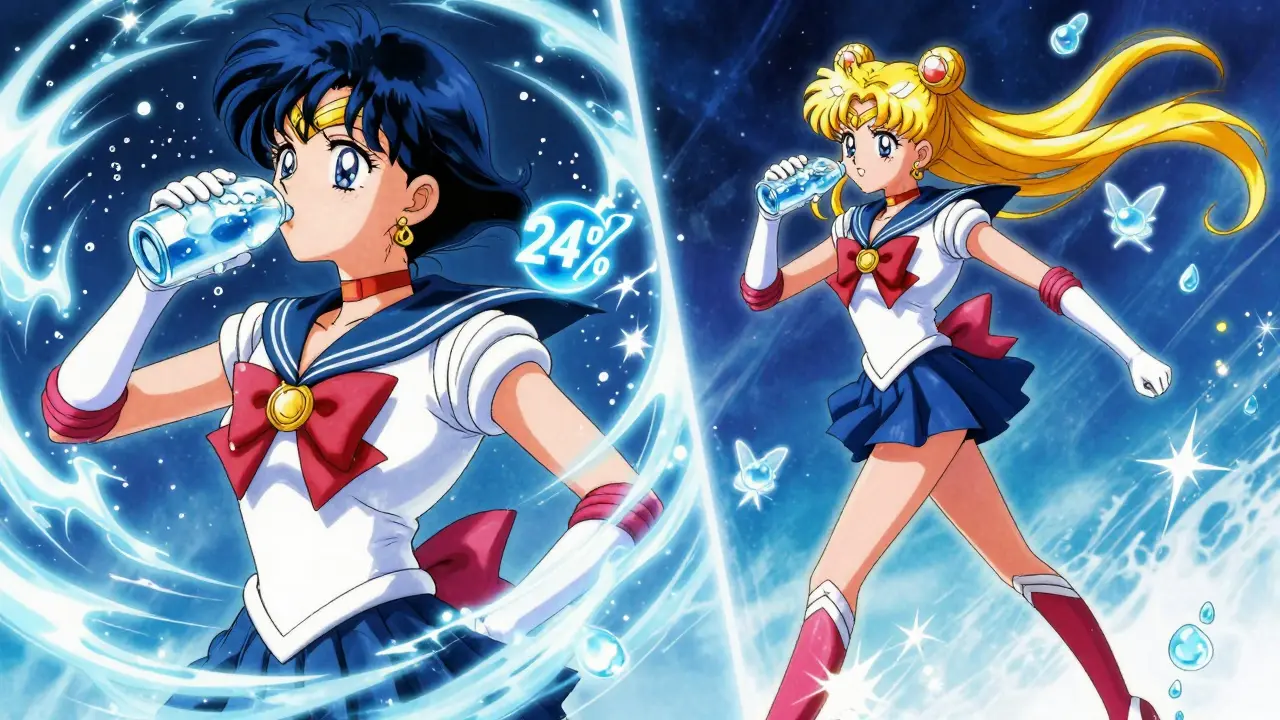
Water vs. Diet Soda: The Real Battle
You might think diet soda is a smart swap. Zero calories, right? But here’s the truth: in an 18-month trial with 81 women with type 2 diabetes, those who switched from diet drinks to plain water lost nearly 2kg more than those who kept drinking diet soda. And 44% of the water group went into diabetes remission - only 22% of the diet soda group did. Why? Artificial sweeteners in diet drinks may confuse your body. They trigger insulin responses without food, which can make you hungrier later. They also change your gut bacteria, which affects how your body stores fat. Water? It does none of that. It just hydrates. If you’re trying to lose weight, ditch the diet soda. Not because it’s “bad,” but because water is better. Period.Performance and Energy: Why You Feel Sluggish When Dehydrated
You don’t need to be sweating to be dehydrated. Even mild dehydration - just 1-2% loss of body water - can make you feel tired, foggy, and unmotivated. And when you’re low on energy, you’re less likely to move. Less movement means fewer calories burned. A study from Oregon State University found that dehydration lowers lipolysis - your body’s ability to break down fat. When you’re short on water, your hormones shift in a way that makes fat storage easier and fat burning harder. That’s why people who drink enough water often feel more alert, have better workouts, and stick to their routines. You’re not just losing weight - you’re building the energy to keep going.How Much Water Should You Actually Drink?
There’s no magic number like “eight glasses a day.” Your needs depend on your size, activity level, and climate. But for weight loss, the research points to one clear target: add 1.5 liters (about 50 oz) to your normal daily intake. If you normally drink 1 liter a day, aim for 2.5 liters. Split it: 500ml before each meal, and the rest spread through the day. Don’t force it. Start with one glass before lunch. Then add one before dinner. Then breakfast. In two weeks, it’ll feel normal. The American Council on Exercise recommends 0.5 to 1 ounce of water per pound of body weight for active people. So if you weigh 70kg (154 lbs), aim for 77-154 oz (2.3-4.5 liters) daily - especially if you’re exercising.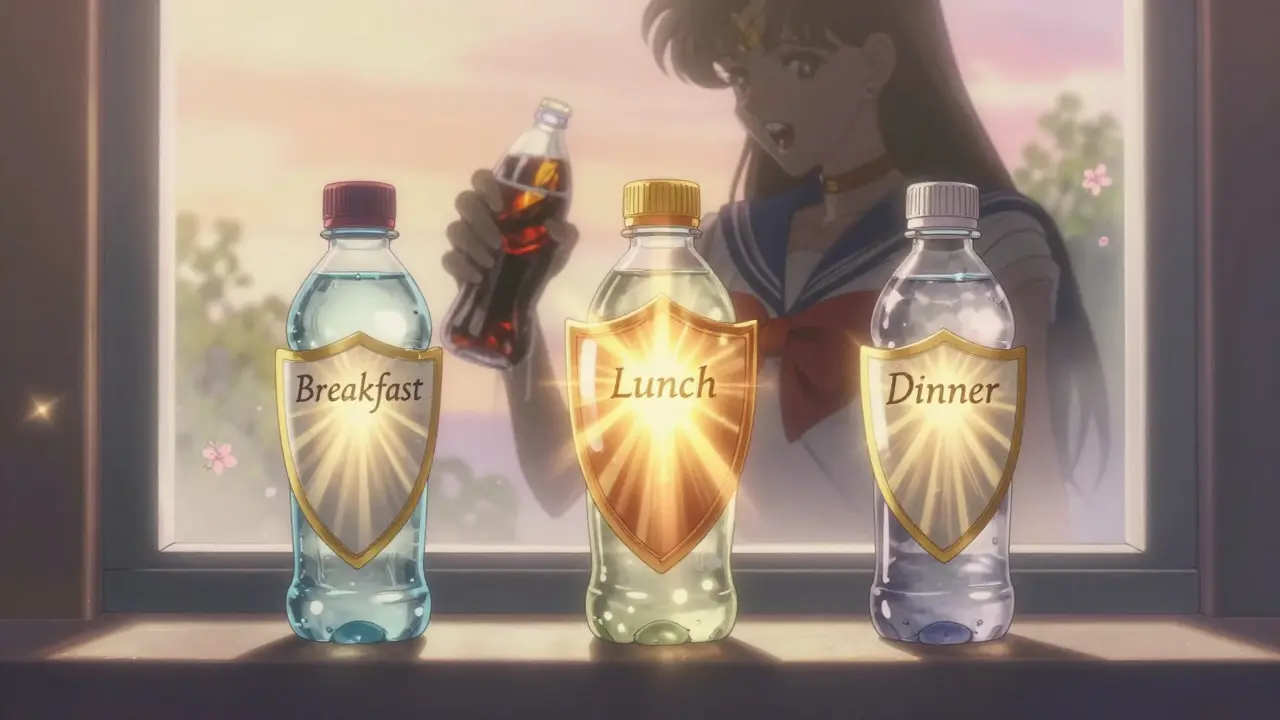
Common Mistakes (And How to Fix Them)
- Mistake: Waiting until you’re thirsty to drink. Fix: Set phone reminders for 10 minutes before each meal.
- Mistake: Drinking too fast. Fix: Sip slowly. Chugging can cause bloating and discomfort.
- Mistake: Thinking water alone will melt fat. Fix: Use it as a tool - not a cure. Pair it with better food choices and movement.
- Mistake: Skipping water on non-meal days. Fix: Hydration is daily. Even on weekends.
It’s Not a Miracle. But It’s One of the Best Tools You Have
Drinking water won’t turn you into a different person overnight. But it’s one of the few weight loss strategies that costs nothing, has zero side effects, and works whether you’re rich or poor, in New Zealand or Nigeria. Studies show it helps you eat less. It helps you burn more. It helps you feel better. And it doesn’t require willpower - just consistency. If you’re serious about losing weight, start here. Fill a bottle before every meal. Drink it slowly. Wait 30 minutes. Then eat. Do that for 30 days. Then check your weight. You might be surprised.Frequently Asked Questions
Does drinking water before meals really help you lose weight?
Yes. Multiple studies, including one published in Obesity (2010) and a 2024 JAMA review, show that drinking 500ml of water 30 minutes before meals leads to significant weight loss - often 1.5-2kg more over 12 weeks compared to those who don’t. The effect comes from reduced calorie intake due to increased fullness.
Can drinking too much water be dangerous?
For healthy adults, drinking up to 2.5-3 liters extra per day is safe. Water intoxication (hyponatremia) is extremely rare and only happens with extreme overconsumption - like drinking 5+ liters in a few hours. For weight loss, 1.5-2 liters added to your usual intake is well within safe limits.
Is tap water okay, or do I need bottled water?
Tap water is perfectly fine. There’s no evidence that bottled water works better for weight loss. In fact, in places like Auckland, tap water is among the cleanest in the world. Save money and the planet - drink from the tap.
What about sparkling water? Does it work the same?
Yes. Plain sparkling water without added sugar or flavorings works just as well as still water for appetite suppression and hydration. The carbonation might even make you feel fuller faster. Avoid sweetened or flavored versions - they can contain hidden calories or artificial sweeteners.
Will drinking water help me lose belly fat specifically?
No targeted fat loss exists. Water doesn’t melt belly fat alone. But by helping you eat fewer calories and improving your metabolism, it supports overall fat loss - including in the abdominal area. Combine it with strength training and healthy eating for the best results.
How long does it take to see results from drinking more water?
Most people notice reduced hunger within a few days. Visible weight loss usually starts in 2-4 weeks. In studies, participants lost measurable weight in as little as 8 weeks with consistent pre-meal water intake.
Should I drink water during workouts?
Absolutely. Staying hydrated during exercise improves endurance, reduces fatigue, and helps your body burn fat more efficiently. Aim to drink 250-500ml every 15-20 minutes during moderate to intense activity.
Ethan Purser
January 4, 2026 AT 13:09Water? That’s it? No supplements? No keto? No 5 a.m. workouts? I feel like I just got handed a magic bean from a guy on a street corner selling ‘miracle elixirs’… but somehow, I’m buying it. Maybe because it’s free. Or maybe because I’ve been chugging diet soda like it’s oxygen and my body’s screaming for mercy.
And now I’m crying. Not because I’m sad. Because I realize I’ve been drinking water like a squirrel on a hot tin roof - sporadic, panicked, and always too late.
Time to change. I’m filling my bottle right now. 30 minutes before my next meal. Even if it’s 2 a.m. and I’m eating cold pizza. I’m doing it. For science. For my future self who isn’t stuck in a body that feels like a wet sock.
Also… I’m gonna tell my mom. She’s gonna hate me for this. She thinks water is for plants. And people who ‘don’t know how to live.’
Doreen Pachificus
January 5, 2026 AT 22:01Interesting. I’ve been drinking water before meals for about a month now. Didn’t realize it was this scientifically backed. I just did it because I kept getting headaches and thought maybe I was dehydrated. Turns out I was also eating less without even trying.
Lost 3 lbs in 3 weeks. Didn’t change anything else. Just water. Weird, right?
Vicki Yuan
January 5, 2026 AT 23:51Let me just say this: hydration is the most underrated performance enhancer on the planet. Not just for weight loss - for focus, mood, skin, digestion, even your immune system. You don’t need a fancy app or a personal trainer. You just need a reusable bottle and the discipline to refill it.
And yes - sparkling water counts. As long as it’s unsweetened and unflavored. I’ve switched entirely to sparkling. It feels like a treat, but it’s just H₂O with bubbles. My stomach loves it. My wallet loves it. My therapist? She’s just glad I’m not drinking Diet Coke anymore.
Pro tip: Keep a bottle at your desk, in your car, and next to your bed. Make it as easy as breathing. Because that’s what hydration is - your body’s default setting.
Also - don’t chug. Sip. Let it work. Your stomach isn’t a vacuum.
And if you think ‘I don’t like water’ - add a slice of lemon. Or cucumber. Or mint. Don’t add sugar. Don’t add sweeteners. Just nature. You’ll thank yourself in 30 days.
Uzoamaka Nwankpa
January 7, 2026 AT 02:03Everyone talks about water like it’s the answer. But what about people who can’t afford bottled water? Or live where tap water is unsafe? Or have kidney issues? Or are on dialysis? This post feels like it was written by someone who’s never had to choose between paying for medicine or buying a case of water.
It’s not that the science is wrong. It’s that the privilege of being able to drink more water is not universal. And pretending it is? That’s not helpful. That’s just another wellness lie wrapped in a ‘simple fix’ bow.
Akshaya Gandra _ Student - EastCaryMS
January 7, 2026 AT 19:13wait so like if i drink water before eating i eat less?? omg i just realized why i always feel so full after lunch but still hungry?? i think i’ve been drinking water after meals not before 😭 i’m gonna try this tomorrow!! also i use a 1l bottle so i just drink half before lunch and half before dinner?? does that work?? pls help
Angie Rehe
January 8, 2026 AT 21:52Let’s be clear: this is not ‘science.’ This is behavioral nudging disguised as physiology. You’re not ‘burning calories’ by drinking cold water - you’re activating a thermogenic response that, in the grand scheme of a 2,000-calorie daily intake, is negligible. You’re not ‘tricking your brain’ - you’re exploiting satiety signals that evolved over millennia to prevent overconsumption. This isn’t a hack. It’s biology.
And yet, you’re selling it like a supplement. ‘Drink water, lose weight!’ - as if the human body is a broken machine you can fix with a single input.
Meanwhile, the real issue - ultra-processed foods, hyperpalatable carbohydrates, and systemic food deserts - is ignored because it’s inconvenient. Water isn’t the solution. It’s a bandage on a gunshot wound.
Aaron Mercado
January 9, 2026 AT 01:36WATER? WATER?!?!? You’re telling me that the ONE THING I’ve been told since I was 5 - ‘DRINK YOUR WATER’ - is actually the SECRET TO WEIGHT LOSS?!?!
MY MOM WAS RIGHT!!!
I’ve been drinking soda, coffee, juice, ‘hydration drinks,’ protein shakes, and ‘electrolyte gels’… and all I needed was… WATER?!?!
I’m 42. I’ve spent $12,000 on diets. I’ve tried intermittent fasting, keto, paleo, vegan, carnivore, and the ‘banana diet’ (yes, that was real).
And now I find out… I could’ve lost 50 pounds just by drinking water before pizza?
I’m not mad. I’m just… stunned. And slightly betrayed by every nutritionist who ever sold me a $90 shake.
Starting tomorrow. 500ml. Before. Every. Meal. Even if I’m eating ramen at 1 a.m.
God. Help me.
P.S. I’m telling my entire family. And I’m buying them all water bottles. With their names on them. I’m doing this right.
Vikram Sujay
January 10, 2026 AT 21:20While the empirical evidence presented is compelling, one must consider the broader context of metabolic individuality. The human body does not respond uniformly to hydration protocols; genetic, epigenetic, and microbiomic variances significantly modulate the thermogenic and satiety responses observed in cohort studies.
Moreover, the notion of a universal 1.5L pre-meal protocol may inadvertently neglect the physiological needs of individuals in thermally extreme environments or those with renal adaptations. A one-size-fits-all prescription, however well-intentioned, risks pathologizing natural variation.
It is not the water itself that is transformative - it is the ritual. The mindfulness. The pause before consumption. That moment of intentionality - not the volume - may be the true catalyst for behavioral change.
Thus, I recommend not merely increasing intake, but cultivating presence with each sip. Let water be not a tool, but a teacher.
John Ross
January 11, 2026 AT 01:55Let’s talk about the elephant in the room - corporate water marketing. Bottled water is a $200 billion industry. And guess what? They don’t want you to know tap water works just as well. They want you to buy $3 plastic bottles while pretending you’re ‘investing in health.’
Meanwhile, in places like India and Nigeria, people walk miles for clean water. And here we are, debating whether sparkling counts as ‘real water’ while ignoring that 2 billion people lack safe access.
So yes - drink water before meals. It helps. But don’t make it a lifestyle brand. Don’t turn hydration into a status symbol. Water is a human right. Not a wellness trend.
And if you’re buying ‘alkaline’ or ‘ionized’ water? You’re being scammed. It’s just H₂O with a fancy label.
bob bob
January 11, 2026 AT 23:11I tried this. For real. Drank water before every meal for 3 weeks. Didn’t change my food. Didn’t start working out. Just water. Lost 4 pounds. My pants are looser. My energy is better. I didn’t even think it would work.
Now I’m telling my coworkers. I’m leaving bottles at their desks. I’m even putting a sticky note on the office fridge: ‘DRINK WATER BEFORE YOU EAT THE DONUT.’
It’s not magic. But it’s the closest thing I’ve found to a free, easy win.
Thanks for the reminder. I needed this.
Abhishek Mondal
January 13, 2026 AT 02:44Oh, so now we’re attributing weight loss to hydration? How quaint. Did you also consider that those who drink more water are more likely to be health-conscious overall? Correlation ≠ causation. The real variable here is self-discipline - not H₂O.
And let’s not forget: the ‘1.5L before meals’ protocol was likely cherry-picked from a study with a small sample size and no control for dietary logs. You’re selling a placebo as a protocol.
Also - why is everyone ignoring the fact that thirst cues are often suppressed in obese individuals due to leptin resistance? Drinking water won’t fix that. It might even worsen it by reinforcing the idea that ‘simple fixes’ exist.
True change requires systemic intervention - not sipping before pizza.