
How to Manage Pediatric Medication Side Effects at Home
 Dec, 28 2025
When your child starts a new medication, you hope it helps them feel better. But what if it makes them sick instead? Side effects are common in kids - more so than in adults - because their bodies are still growing. Their livers and kidneys don’t process drugs the same way. Their immune systems react differently. And sometimes, even the right dose can cause unexpected reactions. The good news? Most side effects can be managed safely at home if you know what to look for and how to respond.
Know the Most Common Side Effects in Children
Not all reactions are emergencies. In fact, the majority are mild and temporary. According to pediatric data from Children’s Hospital of Philadelphia, the most frequent side effects include:- Upset stomach - affects about 42% of children on new medications
- Diarrhea - occurs in nearly 1 in 4 kids
- Drowsiness - seen in 19%, especially with antihistamines or antibiotics
- Hyperactivity - surprising, but 12% of kids get wired instead of sleepy, especially from diphenhydramine (Benadryl)
- Rashes - 23% of children develop skin reactions, from mild red spots to hives
When to Call the Doctor Immediately
Some reactions need urgent attention. Don’t wait. Don’t Google. Call your pediatrician or go to the ER if your child has:- Persistent vomiting - more than three times in a few hours
- High fever - over 102°F (38.9°C) that doesn’t come down with acetaminophen or ibuprofen
- Difficulty breathing - breathing faster than 40 breaths per minute for infants, or 30+ for older kids
- Swelling - of the face, lips, tongue, or throat
- Hives covering more than 10% of the body - especially if they’re spreading quickly
Managing Gastrointestinal Side Effects at Home
Stomach upset and diarrhea are the most common complaints. The goal isn’t to stop it completely - your child’s body is trying to flush out the irritant. The goal is to prevent dehydration.- For vomiting: Wait 30 to 60 minutes after the last episode. Then start with tiny sips - 5 to 10 mL (about a teaspoon) of oral rehydration solution (like Pedialyte) every 5 minutes. Gradually increase the amount as they keep it down. Avoid juice, soda, or milk - they can make diarrhea worse.
- For diarrhea: Stick to bland foods: bananas, rice, applesauce, toast (the BRAT diet). Avoid fried, sugary, or high-fiber foods. Continue breastfeeding or formula as usual. Offer water or rehydration solution between meals.
- Watch for dehydration: Dry lips, no tears when crying, sunken eyes, or fewer wet diapers than usual (less than one every 8 hours for babies, less than three for toddlers). If you see these signs, call your doctor.
Handling Drowsiness and Hyperactivity
Some medications - especially antihistamines like Benadryl - have the opposite effect in kids. Instead of calming them down, they can turn into little tornadoes. One study found 15% of children on diphenhydramine become hyperactive, compared to just 2% of adults.- For drowsiness: Let them rest. Keep the environment calm. Don’t force them to play or eat. Make sure they’re in a safe place - no climbing stairs or using sharp objects.
- For hyperactivity: Track the behavior. Write down what you see: “Ran around for 45 minutes, wouldn’t sit still, screamed when asked to stop.” This helps your doctor decide if it’s a reaction to the medication or something else. Don’t try to sedate them with extra medicine. That’s dangerous.
Preventing Medication Errors at Home
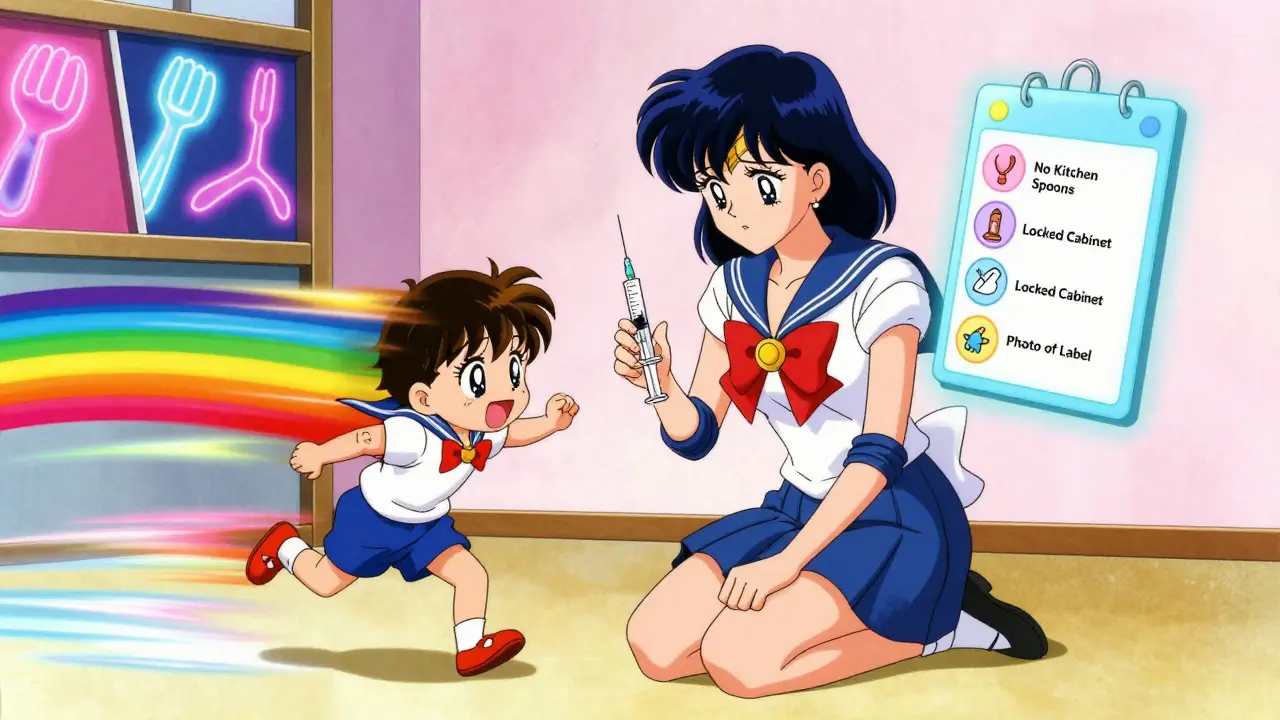
Half the battle is avoiding mistakes before they happen. Most pediatric medication problems aren’t caused by the drug itself - they’re caused by how it’s given.- Use the right tool: Never use a kitchen spoon. Use an oral syringe with 0.1 mL markings. That’s the only way to measure small doses accurately. A teaspoon is 5 mL. A tablespoon is 15 mL. Confusing them can mean a 300% overdose.
- Keep the original bottle: Never transfer medicine to another container - even if it looks cleaner. Kids can mistake it for juice. Studies show this increases poisoning risk by 41%.
- Store it safely: Keep all meds locked up, at least 5 feet high. Use cabinets with childproof locks. The Poison Prevention Packaging Act says medicine containers must be child-resistant - and they work. 92% of kids under 5 can’t open them.
- Take a photo: Before giving any new medication, snap a picture of the label. That way, if you forget the name or dose, you’ve got a backup.
Storage and Stability Matter
Medicines aren’t like cereal. They need the right temperature. Most liquid pediatric meds should be stored at 20-25°C (68-77°F). About 73% require refrigeration. If you leave them on the counter, they can lose strength or even grow mold.- Check the label. If it says “refrigerate,” keep it in the fridge - not the door, where temperatures swing.
- Don’t freeze unless instructed. Freezing can break down the medicine.
- Write the expiration date on the bottle with a marker. Liquid antibiotics often expire after 14 days, even if the bottle says otherwise.
Use Technology Wisely
New tools are making home care safer. Apps like MedTrak Pediatric (launched in late 2023) let you scan the barcode on a medicine bottle and get reminders for doses, side effects to watch for, and even alerts if you’re about to give a duplicate drug.- Set phone alarms for doses - especially at night.
- Use the app to log symptoms: “Child vomited at 3 PM. Gave 5 mL Pedialyte. No more vomiting after 6 PM.”
- Some apps now show you a picture of the pill or liquid, so you can double-check you’re giving the right one.
What to Do If You’re Not Sure
You’re not alone. Most parents feel unsure. That’s why you have resources.- Call Poison Control: 1-800-222-1222. It’s free, 24/7, and staffed by nurses and pharmacists who specialize in pediatric cases.
- Use telehealth. Between 2020 and 2023, telehealth visits for medication questions jumped from 12% to 47% of pediatric appointments. You can get expert advice without leaving home.
- Keep a written log. Note the time you gave the medicine, the dose, what your child did afterward, and how long it lasted. This helps your doctor spot patterns.
Future Improvements Are Coming
The system is slowly getting better. In 2023, the FDA proposed a new Pediatric Medication Safety Act that would require all new drugs to include child-specific dosing instructions and side effect guides. Right now, only 62% of medications have proper pediatric labeling. Also, picture-based instructions - showing a child taking medicine, not just writing “take with food” - are being tested. Early results show they reduce errors by 79% in families with low health literacy. But for now, the tools you have are enough - if you use them right.What should I do if my child vomits right after taking medicine?
Wait 30 to 60 minutes, then try giving half the original dose again. If they vomit a second time, don’t give more. Call your pediatrician. Giving extra doses can lead to overdose, especially with antibiotics or pain relievers.
Can I give my child over-the-counter medicine to help with side effects?
Only if your doctor says so. Giving extra medicine - like giving Tylenol for a fever caused by antibiotics - can lead to double-dosing. Many pediatric meds already contain acetaminophen or ibuprofen. Mixing them accidentally can cause liver damage.
How do I know if a rash is an allergic reaction or just a side effect?
A side effect rash is usually flat, red, and doesn’t spread fast. An allergic reaction rash is raised (hives), itchy, and spreads quickly. If it’s on the face, lips, or tongue - or if your child is wheezing or having trouble breathing - treat it as an emergency. Call 911.
My child refuses to swallow pills. What can I do?
Try the candy method: start with crushed Nerds, then move to Mini M&Ms, then regular M&Ms over two weeks. Nationwide Children’s Hospital found this works for 89% of kids aged 8-12. Always check with your pharmacist first - some pills shouldn’t be crushed.
Is it safe to use a kitchen measuring spoon if I don’t have a syringe?
No. Kitchen spoons vary wildly in size. A teaspoon might hold 3 mL or 7 mL - you can’t trust it. An oral syringe with 0.1 mL markings is the only safe option. They cost under $5 at any pharmacy.
What if my child accidentally takes too much medicine?
Call Poison Control immediately at 1-800-222-1222. Don’t wait for symptoms. Don’t try to make them throw up. Have the medicine bottle ready - they’ll need the name, dose, and time taken. Even if your child seems fine, some overdoses take hours to show up.
Should I stop the medicine if side effects start?
Only if it’s an emergency. For mild side effects like drowsiness or upset stomach, keep giving the medicine unless your doctor says otherwise. Stopping antibiotics early can cause infections to come back stronger. Always talk to your provider before stopping anything.
Janette Martens
December 28, 2025 AT 12:29Marie-Pierre Gonzalez
December 29, 2025 AT 03:17Louis Paré
December 29, 2025 AT 08:24Celia McTighe
December 30, 2025 AT 19:32Ryan Touhill
December 31, 2025 AT 11:19Teresa Marzo Lostalé
January 2, 2026 AT 11:08ANA MARIE VALENZUELA
January 3, 2026 AT 12:13oluwarotimi w alaka
January 5, 2026 AT 02:41Debra Cagwin
January 5, 2026 AT 08:14Hakim Bachiri
January 7, 2026 AT 02:39Ellen-Cathryn Nash
January 7, 2026 AT 20:16