
How to Prevent Wrong-Dose Errors with Liquid Medications: A Practical Guide for Patients and Providers
 Jan, 27 2026
Every year, thousands of people - especially children - get sick or end up in the hospital because someone gave them the wrong amount of liquid medicine. It’s not because someone was careless. It’s because the system is still built on outdated tools and confusing instructions. You might think, How hard can it be to measure a teaspoon? But here’s the truth: a kitchen teaspoon isn’t the same as a medical teaspoon. And that small difference can mean the difference between healing and harm.
Why Liquid Medication Errors Are So Common
Liquid medications are one of the most dangerous types of drugs to get wrong. Unlike pills, you can’t just count them. You have to measure. And measuring liquids is where things go wrong - fast. A 2023 study in the Journal of Pediatrics found that 80% of pediatric home medication errors involve liquid drugs. In emergency rooms, nearly half of caregivers give doses that are more than 20% off from what the doctor ordered. One in four gives more than 40% extra. That’s not a typo. That’s a real risk of overdose. Why does this happen? Three big reasons:- Wrong tools: People use kitchen spoons, shot glasses, or dosing cups with unclear markings.
- Confusing units: Prescriptions still say “teaspoon” or “tablespoon,” even though those aren’t exact measurements.
- Lack of training: Pharmacists don’t always hand out the right measuring device. Parents aren’t shown how to use it.
The #1 Fix: Ditch the Dosing Cup - Use an Oral Syringe
If you’re giving liquid medicine to a child - or anyone - the single most effective thing you can do is stop using dosing cups. They’re inaccurate. Period. A 2016 study from Yale School of Medicine found that oral syringes are 37% more accurate than dosing cups. For doses under 5 mL, syringes have an error rate of just 8.2%. Dosing cups? 41.1%. That’s more than five times worse. The American Academy of Family Physicians and the American Academy of Pediatrics both recommend oral syringes only for pediatric liquid meds. Why? Because they’re precise. They have clear 0.1 mL markings. You can measure 1.7 mL exactly. You can’t do that with a cup. Here’s what to do:- Ask your pharmacist for an oral syringe every time you get a liquid prescription.
- If they say, “We don’t have one,” insist. It’s your right.
- If you’re at home and don’t have one, buy them online or at a pharmacy. They cost less than $1 each.
- Never use a kitchen spoon. Even if the label says “1 tsp.” That’s not safe.
Stop Using Teaspoons and Tablespoons - Use mL Only
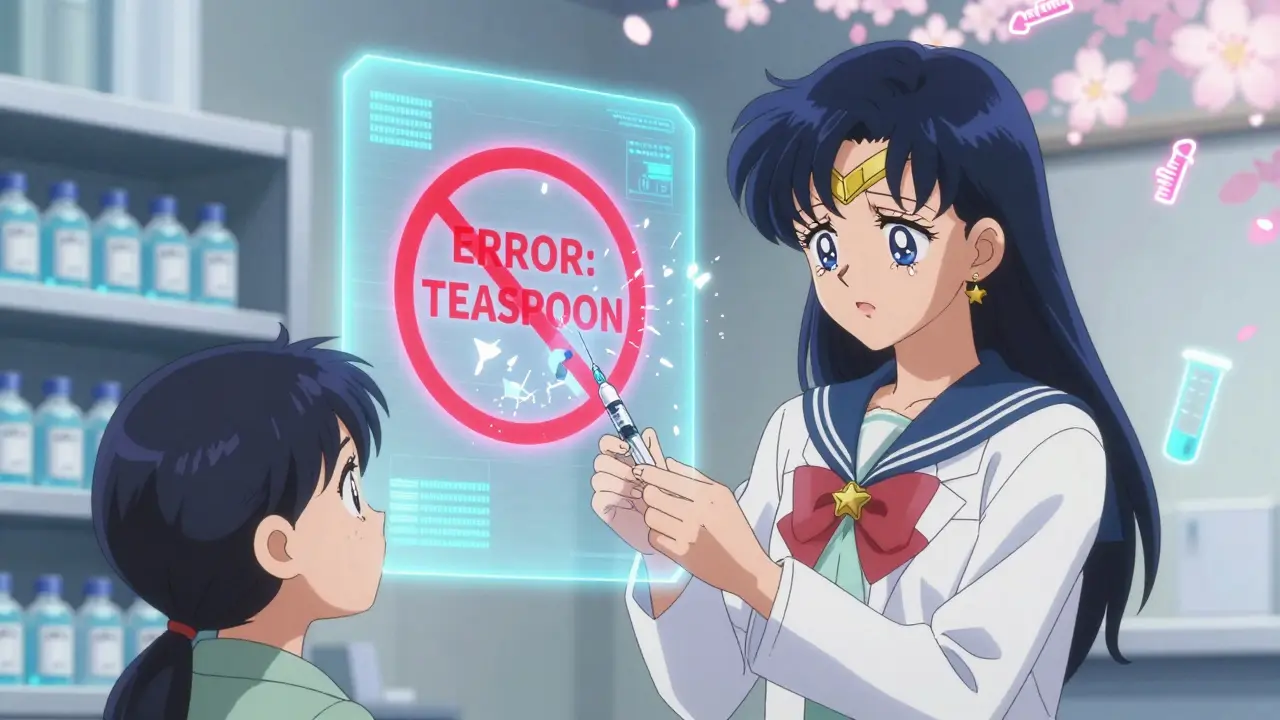
The biggest source of confusion? Units. A teaspoon isn’t 5 mL. A tablespoon isn’t 15 mL. In kitchens, they vary. In medicine, they must be exact. Dr. Michael Cohen, president of ISMP, says 28% of preventable pediatric errors come from prescriptions using “teaspoon” or “tablespoon.” That’s not a small number. That’s nearly one in three. The World Health Organization says eliminating non-metric units is the single most effective way to cut these errors. And they’re right. Here’s how to fix it:- Always ask for the dose in milliliters (mL), never teaspoons.
- Make sure the prescription label says “2.5 mL,” not “1 tsp.”
- If the label says both, cover up the tsp part. Only trust the mL.
- Teach everyone who gives the medicine: “mL is the only unit that matters.”
What Hospitals and Pharmacies Should Be Doing
In hospitals, the tools are better - but not everywhere. The ENFit connector is a game-changer. Since 2016, ISO standards require that enteral (tube-fed) medications have connectors that cannot plug into IV lines. Before ENFit, a child could get a feeding tube dose through an IV by accident - and die. Now, it’s nearly impossible. Hospitals that switched saw a 98% drop in wrong-route errors. But only 42% of U.S. hospitals have fully adopted ENFit. Many still use old, dangerous connectors. Other proven hospital practices:- Barcode scanning: Nurses scan the patient’s wristband and the medication. If it doesn’t match, the system alerts them. This cuts errors by 48%.
- Computerized order entry (CPOE): When a doctor types “give 5 mL of amoxicillin,” the system checks the child’s weight and warns if the dose is too high. This reduces calculation errors by 58%.
- Pharmacist-led education: At Kaiser Permanente, pharmacists spend 15 minutes with every parent before discharge. Result? A 92% drop in home dosing errors.
What You Can Do at Home
You don’t need a hospital to keep your family safe. Here’s your simple action plan:- Get an oral syringe. Always. No exceptions.
- Measure in mL only. Ignore teaspoons. Trust the number with mL after it.
- Use the syringe that came with the medicine. Don’t reuse a dirty one. Don’t swap it for a different size.
- Hold the syringe at eye level. Look straight at the line. Don’t tilt it.
- Write down the dose. Keep a small note on the fridge: “3.2 mL at 8 a.m. and 8 p.m.”
- Ask for help. If you’re unsure, call the pharmacy. Don’t guess.

The Hidden Cost of Errors - And Why It Matters
Wrong doses aren’t just inconvenient. They’re deadly. The U.S. spends $8.3 billion a year treating errors from liquid medications. That’s more than $1 billion in New Zealand alone. And 14% of these errors lead to permanent harm or death. The FDA has been pushing for change since 2010. In 2024, they proposed new rules: all over-the-counter liquid meds must come with a proper dosing device. No more “just use a spoon.” And it’s working. From 2015 to 2022, reported errors dropped by 28%. But we’re not done. Rural clinics still lack syringes. Elderly patients still use cups. Parents still use spoons. The solution isn’t technology alone. It’s culture. It’s training. It’s asking the right questions.What’s Next? The Future of Liquid Medication Safety
The future is coming fast. At Boston Children’s Hospital, they’re testing smartphone apps that use augmented reality to show you exactly where the dose line should be - right on your syringe. At Johns Hopkins, RFID-tagged syringes talk to the hospital’s computer system and log every dose automatically. By 2026, all certified electronic health records in the U.S. will be required to check pediatric doses automatically. That means your doctor’s system will catch a wrong dose before it’s even written. But none of this matters if you’re still using a kitchen spoon. The most powerful tool you have isn’t an app. It’s not a barcode scanner. It’s your awareness.Final Checklist: Your Liquid Medication Safety Plan
Before you give any liquid medicine, run through this:- ✅ Is the dose written in mL? If not, ask for it.
- ✅ Do you have an oral syringe? If not, get one now.
- ✅ Is the syringe clean and the right size for the dose?
- ✅ Are you holding it at eye level and reading the line straight on?
- ✅ Are you sure you’re giving it to the right person?
- ✅ Did you write down the time and dose?
Why can’t I just use a kitchen teaspoon to give liquid medicine?
Kitchen teaspoons vary in size - they can hold anywhere from 3 mL to 7 mL. Medical teaspoons are standardized at exactly 5 mL, but even that’s not used anymore. The only safe way to measure is in milliliters (mL) using an oral syringe. Using a kitchen spoon increases the risk of overdose or underdose by up to 50%.
What’s the best tool for measuring liquid medicine?
An oral syringe is the best tool. It’s precise, easy to read, and designed for medicine. For doses under 1 mL, use a 1 mL syringe with 0.1 mL markings. For doses between 1 and 5 mL, use a 5 mL syringe with 0.5 mL markings. Dosing cups and household spoons are unreliable and should never be used.
Why do pharmacies still give out dosing cups?
Some pharmacies still give dosing cups because they’re cheaper and easier to stock. But this practice is outdated and unsafe. The American Academy of Pediatrics and ASHP have banned dosing cups for pediatric use since 2015. If you’re given a cup, ask for a syringe instead. You have the right to the safest tool.
Are there any apps or gadgets that help with liquid dosing?
Yes. Some hospitals are testing augmented reality apps that show you the correct dose line on your syringe using your phone’s camera. RFID-tagged syringes that auto-log doses are also in pilot programs. But these are still emerging. For now, the best tech is a simple oral syringe and a clear mL label.
What should I do if I think I gave the wrong dose?
Call your pharmacist or doctor right away. Don’t wait. Even if the person seems fine, some overdoses take hours to show symptoms. Have the medicine bottle and syringe ready when you call. They’ll tell you whether to watch, seek help, or go to the ER. It’s always better to be safe.
Linda O'neil
January 29, 2026 AT 10:45Just got my kid’s antibiotics today - asked for the syringe, and the pharmacist acted like I was asking for a unicorn. Seriously? It’s $1. I had to go to the next pharmacy. Stop normalizing dangerous habits. Oral syringes aren’t optional. They’re basic.
Also, if your label says ‘1 tsp’ - cover it with tape. Only trust mL. I keep a Sharpie in my medicine cabinet now. Game changer.
Phil Davis
January 30, 2026 AT 12:55Wow. A whole article about not using spoons. Who knew? Next up: ‘How to Avoid Breathing Air - A Practical Guide for Humans.’
At least we’re finally admitting that ‘teaspoon’ was never a real unit. Took long enough. Now if only the FDA could figure out why we still let pharmacies sell ‘universal’ dosing cups that fit zero things properly.
Irebami Soyinka
February 1, 2026 AT 10:08USA still using spoons?! 😂 My niece in Lagos gets medicine in syringes from birth - even the street pharmacists know better. You people pay $300 for a smart fridge but won’t buy a $0.99 syringe?
My people don’t wait for FDA to catch up. We fix it ourselves. You want safety? Stop waiting for permission. Go buy the syringe. NOW.
🫡 #AfricanCommonSense #NoMoreTeaspoons
Katie Mccreary
February 1, 2026 AT 23:5580% of pediatric errors? Wow. So what? You think this is news? Every mom I know has had a panic moment over a dosing cup. The system’s broken. The providers are lazy. The parents are exhausted.
And yet - nobody’s holding pharmacies accountable. Nobody’s suing. Nobody’s even mad. We just shrug and use the cup anyway. That’s the real tragedy. Not the spoon. The apathy.
SRI GUNTORO
February 3, 2026 AT 19:18It’s not just about the syringe. It’s about trust. Why do you think people use kitchen spoons? Because they don’t trust doctors. They don’t trust labels. They don’t trust pharmacies.
When you give someone a prescription with ‘1 tsp’ printed in bold and ‘2.5 mL’ in tiny letters? You’re telling them: ‘You’re not smart enough to read the real number.’
That’s not negligence. That’s disrespect. And it’s why people ignore the rules.
Kevin Kennett
February 4, 2026 AT 22:58Let me tell you what I saw last week. Mom, 3 kids, 3 different liquid meds. One had a syringe. One had a cup. One had a shot glass. The mom was crying because she thought she gave too much.
I handed her my spare syringe. She hugged me. That’s not healthcare. That’s survival.
Pharmacies: if you’re still handing out cups, you’re part of the problem. Stop hiding behind ‘we’re out of stock.’ You’re not. You just don’t care.
And yes - I’m yelling. Because someone has to.
Jess Bevis
February 6, 2026 AT 00:48Just got back from India - they use syringes for everything. Even for cough syrup. No exceptions. No excuses. And they’re not rich.
It’s not about money. It’s about culture. We treat medicine like a suggestion. Other cultures treat it like a lifeline.
Maybe we need to stop pretending ‘just be careful’ is enough. It’s not.
Rhiannon Bosse
February 6, 2026 AT 15:09Okay but… what if the syringe is contaminated? What if the pharmacy reuses them? What if the 0.1 mL markings are printed wrong? What if the FDA is lying about the 98% drop in errors? What if this is all a Big Pharma ploy to sell more syringes and make parents paranoid?
I read a blog once that said dosing cups are actually safer because they’re ‘more intuitive.’
Also, my cousin’s dog got sick from liquid medicine once. So… yeah. I’m not convinced.
Just saying. 🤔