
How to Read the NDC Number to Confirm the Correct Medication
 Dec, 29 2025
Every year, thousands of medication errors happen because someone misread a number on a pill bottle. Not because they were careless - but because the NDC number looked confusing. It’s not just a random string of digits. It’s a precise code that tells you exactly what drug you’re holding, how strong it is, and how it’s packaged. If you get it wrong, you could give a patient 20mg instead of 10mg. Or a capsule instead of a liquid. That’s not a small mistake. That’s dangerous.
What Is an NDC Number?
The National Drug Code, or NDC, is a 10-digit number assigned to every prescription and over-the-counter medicine sold in the United States. It’s required by law under the Drug Listing Act of 1972. Think of it like a barcode for drugs - but instead of scanning it, you have to read it. And if you read it wrong, you’re reading the wrong medicine.
The NDC isn’t one fixed format. It comes in three possible layouts: 4-4-2, 5-3-2, or 5-4-1. That means the digits are split into three parts, but the number of digits in each part changes depending on the drug. The first segment is the labeler code - this identifies the company that made or repackaged the drug. The second is the product code - this tells you the active ingredient, strength, and dosage form (like tablet, capsule, or injection). The third is the package code - this shows you how many units are in the container, like 100 pills or 30 mL.
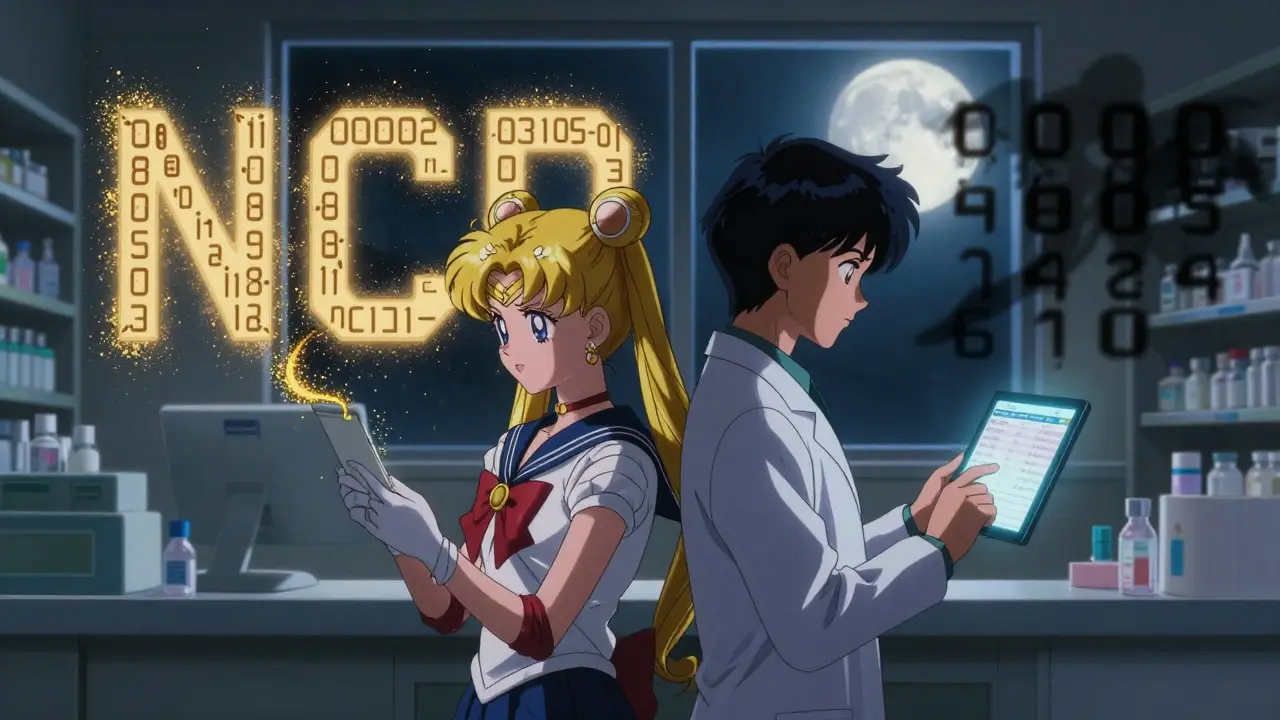
For example, an NDC like 00002-3105-01 breaks down as:
- 00002 = labeler code (Eli Lilly)
- 3105 = product code (fluoxetine 10mg capsule)
- 01 = package code (bottle of 100 capsules)
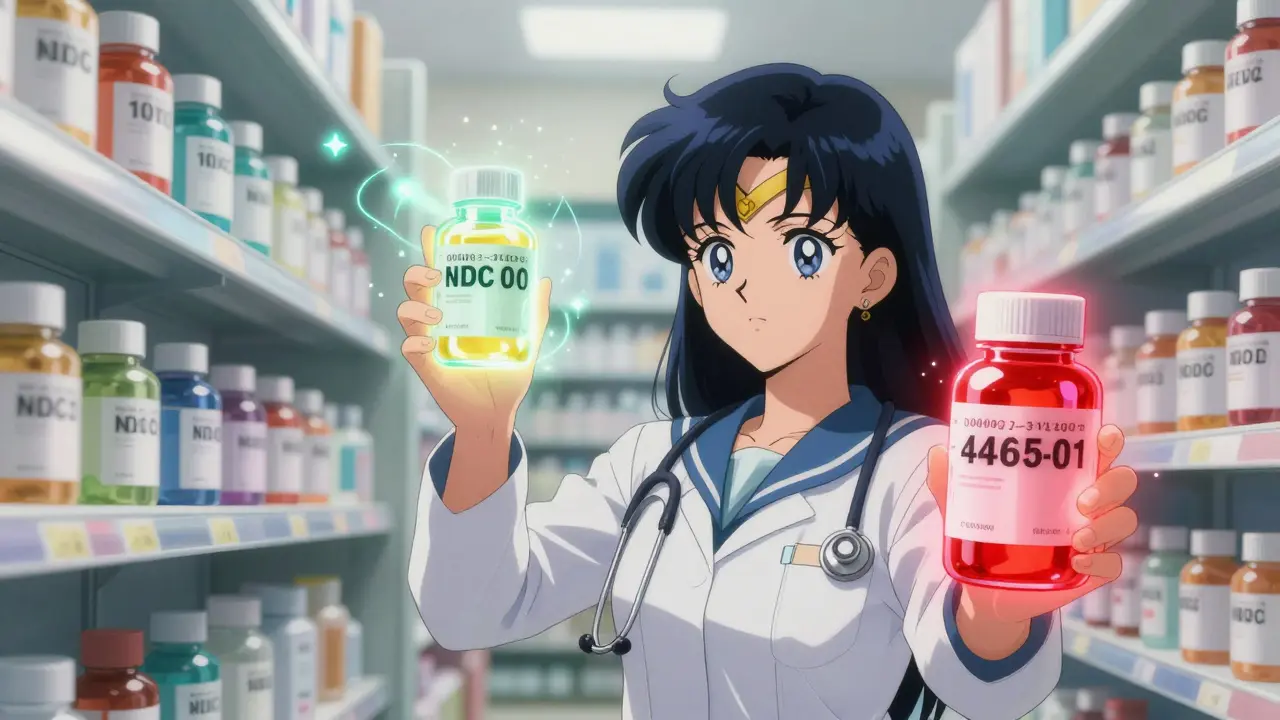
But if you see 00002-4465-01, that’s a different drug entirely - fluoxetine 20mg capsule. The product code changed. That’s the difference between a safe dose and a dangerous one.
Where to Find the NDC on the Packaging
You’ll find the NDC printed on the label of every medication container: vials, blister packs, bottles, tubes. It’s usually near the lot number and expiration date. Sometimes it’s printed in a box or highlighted in red on the label, especially in institutional settings like hospitals and pharmacies. Don’t assume it’s the same as the barcode - the NDC is always printed as numbers, even if a barcode is nearby.
Some labels show the NDC with hyphens (like 00002-3105-01). Others show it without (00002310501). Both are valid. But you must know which format you’re looking at before you interpret it. If the hyphens are missing, count the digits from left to right. A 10-digit code without hyphens still follows one of the three formats. You just have to figure out where the breaks are.
How to Read the NDC Correctly
Verifying the NDC isn’t just glancing at it. It’s a three-step check:
- Identify the format. Count the digits between hyphens. Is it 4-4-2? 5-3-2? 5-4-1? If there are no hyphens, mentally split the 10 digits into the most likely configuration based on the labeler code length. Most large manufacturers use 5-digit labeler codes, so 5-3-2 or 5-4-1 are common.
- Match each segment to the prescription. Does the labeler code match the manufacturer listed on the script? Does the product code match the drug name, strength, and form? If the script says “fluoxetine 10mg capsule,” the product code must be 3105 - not 4465. Does the package code match what was ordered? If you ordered a 30-count bottle but got a 100-count, that’s a red flag.
- Double-check with the FDA directory. Go to the FDA’s NDC Directory online. Type in the 10-digit code. It will show you the exact product name, manufacturer, strength, and package size. If what you see on the label doesn’t match the FDA record, don’t dispense it. Call the supplier.
One pharmacist in Wisconsin caught a fatal error when she noticed the product code on a bottle of Prozac changed from 3105 (10mg) to 4465 (20mg). The label looked identical. The color was the same. But the NDC told the truth. She stopped the fill. The patient was scheduled for a high-risk procedure - the wrong dose could have caused seizures.

Why the 11-Digit Billing Format Matters
Here’s where things get tricky. The NDC on the bottle is 10 digits. But when you bill Medicare, Medicaid, or private insurers, you must use an 11-digit version in the 5-4-2 format. That means you have to add a zero to make it fit.
For example:
- Original label: 00002-3105-01 (5-3-2 format)
- Billing version: 00002-03105-01 (5-4-2 format)
You add the zero to the product code segment - not the labeler or package. This is a common point of confusion. Add it to the wrong segment, and your claim gets rejected. Or worse, the wrong drug gets billed. CMS requires this format. Insurance systems won’t accept anything else.
Many electronic health record systems auto-convert the NDC, but you still need to verify the result. Don’t trust the software blindly. Always cross-check the 11-digit version against the physical label.
Common Mistakes and How to Avoid Them
People mess up NDCs in predictable ways:
- Mixing up product and package codes. A 5-3-2 code like 12345-678-90 might be misread as 12345-67-890. The last two digits become the package code, but someone thinks they’re part of the product code. That leads to giving the wrong strength or form.
- Assuming all NDCs are the same format. Just because one drug uses 5-4-1 doesn’t mean the next one does. Always count the digits.
- Ignoring discontinued codes. The FDA deactivates about 8,500 NDCs each year. If you’re using an old label or outdated database, you might be dispensing a drug that’s no longer approved.
- Not verifying repackaged drugs. If a hospital repackages a drug into a different container, it gets a new NDC. That new code might not match the original manufacturer’s code. Always check the repackager’s label.
The best way to avoid these? Use a two-person verification system for high-risk medications. One person reads the NDC aloud, segment by segment. The other checks the prescription and the FDA directory. It adds 37 seconds to the process - but it prevents errors that cost lives.
What You Can’t Rely On
Here’s the hard truth: the NDC doesn’t tell you everything. It won’t tell you if a drug has different inactive ingredients - like dyes or fillers - that might cause allergies. Two drugs can have the same NDC but different formulations. That’s rare, but it happens. Also, the NDC doesn’t prove the drug is authentic. Counterfeiters can copy the number.
That’s why you still need to check the manufacturer’s name, inspect the packaging for tampering, and confirm the drug looks right. A 10mg tablet should look like a 10mg tablet - not a 40mg tablet painted to look smaller. The NDC is your first line of defense, not your only one.
Tools and Resources
You don’t have to memorize every NDC. There are free tools to help:
- The FDA’s NDC Directory - updated daily, searchable by code, drug name, or manufacturer.
- The NCPDP Standard Interpretation Guidelines - for billing and claims formatting.
- The FDA’s 24/7 NDC hotline: 1-855-543-3784.
- Mobile apps from AAPC and ResDAC - for quick lookup on the pharmacy floor.
Most pharmacies use integrated systems that auto-verify NDCs against prescriptions. But if your system goes down, you still need to know how to read the code by hand. Practice with real examples. Try matching NDCs from old prescriptions to the FDA database. It’s like learning to read a map - once you know the symbols, you never forget.
Why This Matters
In 2023, the Institute for Safe Medication Practices reported that 12% of all dispensing errors involved misreading the NDC. That’s not a small number. It’s one in every eight mistakes. And those mistakes aren’t just inconvenient - they lead to hospitalizations, overdoses, and deaths.
The Drug Supply Chain Security Act now requires every package to be traced using its NDC. That means the code isn’t just for pharmacists anymore. It’s part of the national drug safety network. If you mess up the NDC, you’re not just risking a patient - you’re breaking the chain of accountability.
And soon, things will change again. By 2025, the FDA plans to standardize all NDCs to 12 digits. No more format confusion. No more zero-padding for billing. But until then - you need to know how to read the current ones. Because right now, someone’s life depends on you getting it right.
What does each part of the NDC number mean?
The NDC has three segments: the labeler code (first 4-6 digits) identifies the manufacturer, the product code (next 3-4 digits) specifies the drug’s active ingredient, strength, and dosage form, and the package code (last 1-2 digits) indicates the container size and type. Together, they uniquely identify the exact medication product.
Why is the NDC sometimes 10 digits and sometimes 11 digits?
The 10-digit NDC is printed on the drug label. The 11-digit version is used for billing and insurance claims, following a 5-4-2 format. To convert, you add a leading zero to whichever segment is too short - usually the product code - to make it fit the 5-4-2 structure required by Medicare and other payers.
Can two different drugs have the same NDC?
No. Each NDC is unique to one specific product: manufacturer, strength, dosage form, and package size. If two drugs have the same NDC, one is counterfeit or mislabeled. Always verify against the FDA’s NDC Directory if there’s any doubt.
How do I know if an NDC is still active?
Check the FDA’s NDC Directory. It lists only active drug products. If the NDC isn’t found there, it may have been discontinued or deactivated. Never dispense a drug with a non-listed NDC - it’s not FDA-approved.
What should I do if the NDC on the bottle doesn’t match the prescription?
Stop. Do not dispense. Contact the prescribing provider or the manufacturer to confirm the correct product. There may be a labeling error, a repackaging issue, or a wrong shipment. Never assume the prescription is wrong - always verify the physical product first.
Samar Khan
December 31, 2025 AT 07:15Russell Thomas
January 1, 2026 AT 05:36Joe Kwon
January 1, 2026 AT 19:34Emma Duquemin
January 2, 2026 AT 00:55Kevin Lopez
January 2, 2026 AT 12:49Nicole K.
January 3, 2026 AT 13:28Fabian Riewe
January 4, 2026 AT 02:35Amy Cannon
January 4, 2026 AT 14:27Himanshu Singh
January 4, 2026 AT 23:00Teresa Rodriguez leon
January 5, 2026 AT 06:19Tamar Dunlop
January 5, 2026 AT 15:40David Chase
January 6, 2026 AT 12:52Jasmine Yule
January 7, 2026 AT 02:46Greg Quinn
January 7, 2026 AT 21:41