
How to Request Translator Services for Medication Counseling
 Mar, 5 2026
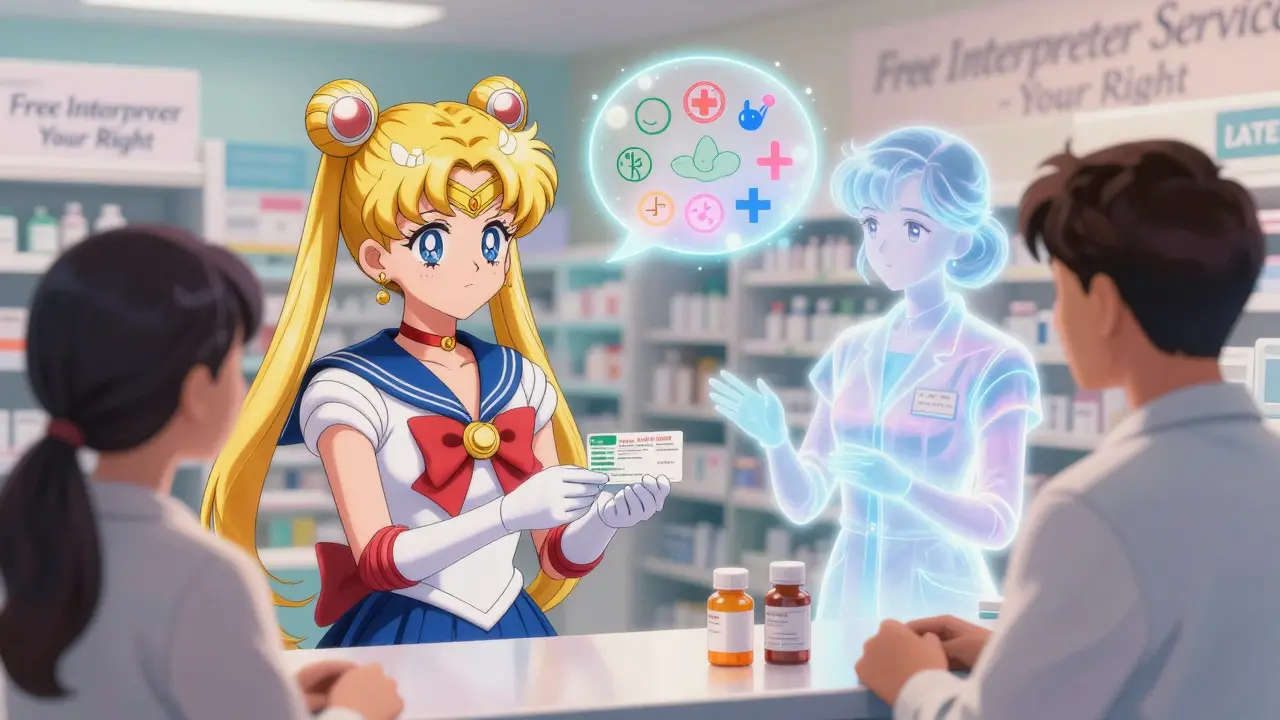
When you pick up a new prescription, the pharmacist should explain how to take it - what time of day, whether to eat with it, what side effects to watch for. But if English isn’t your first language, that conversation can easily get lost. That’s where translator services for medication counseling come in. By law, pharmacies that receive federal funding must provide qualified interpreters at no cost to you. It’s not a perk. It’s a requirement. And it’s not optional for the pharmacy - it’s a matter of safety.
Why Language Help Isn’t Optional
A 2012 study from the University of California San Francisco found that patients with limited English proficiency (LEP) make medication errors at three times the rate of English-speaking patients when no interpreter is available. These aren’t small mistakes. They’re missed doses, wrong amounts, dangerous interactions - all because critical instructions didn’t get through. The fix? Professional interpreters trained in medical terminology. Not a family member. Not a bilingual cashier. Not a translation app. A person who knows how to say "take once daily after breakfast" in your language - and understands what "after breakfast" means in your cultural context.How to Ask for Help - The Right Way
You don’t have to wait for the pharmacist to notice you’re struggling. Take control. When you hand over your prescription, say clearly: "I need a professional interpreter for my medication counseling." Don’t say, "Can you explain this?" or "Do you speak [language]?" That puts the burden on them to guess your needs. Be direct. Federal law under Section 1557 of the Affordable Care Act says they must provide this service - and they can’t charge you. If you’re at a chain pharmacy like CVS, Walgreens, or Rite Aid, ask for the interpreter service right at the counter. Most have phone or video options ready to go. If the staff hesitates, ask: "Is this covered under federal language access rules?" That usually gets their attention. You’re not asking for a favor. You’re exercising a legal right.What Kind of Help Is Available?
There are three main ways pharmacies provide interpreter services: phone, video, and in-person.- Phone interpreting: Fast and cheap. Most pharmacies use a service that connects you to an interpreter in under 30 seconds. But it’s not perfect. A 2019 study at Massachusetts General Hospital found 32% of older patients got confused when trying to follow instructions over the phone - especially if the interpreter had poor audio quality or the patient couldn’t hear clearly.
- Video interpreting: This is becoming the most popular choice. You see the interpreter on a screen, which helps with body language and facial expressions. About 65% of healthcare providers use this method. It costs a bit more than phone, but it’s better for explaining things like inhaler use or insulin injections. Still, tech glitches happen. About 28% of video sessions have connection issues, according to CMS data.
- In-person interpreters: This is the gold standard. A trained interpreter sits with you and the pharmacist. You can point to pills, watch demonstrations, ask follow-up questions. But they’re hard to find outside big cities. Only urban pharmacies reliably have them on staff.
What Languages Are Covered?
California leads the country with its SafeRx program. Since 2013, all pharmacies there must have written directions (SIGs) translated into five languages: Spanish, Chinese, Korean, Russian, and Vietnamese. These aren’t rough translations - they’re reviewed by medical linguists to make sure terms like "take twice daily" make sense in those languages. A 2022 survey found Vietnamese speakers praised the clarity, but Russian speakers said some dosage instructions were confusing because the grammar didn’t match how medical terms are structured in Russian. Other states are catching up. In 2024, California started pilot programs for Tagalog and Arabic translations in Los Angeles County pharmacies. That’s because 22% of LEP patients there speak languages beyond the original five. Nationwide, pharmacies are expected to cover the top 10-15 languages spoken by Medicaid patients - which include Arabic, Hmong, Punjabi, and Somali.
What You Should Never Accept
Never let a pharmacy use a child, family member, or untrained staff member as an interpreter - even if they seem fluent. A 2021 study in JAMA Pediatrics found using untrained people increases the risk of serious medication errors by 49%. Why? Because they don’t know medical terms. They might say "take it before bed" when the instruction is "take it at bedtime," and those two things aren’t the same. Or they might skip warnings about alcohol interactions because they don’t realize it’s important. The same goes for bilingual pharmacy staff. Just because someone speaks two languages doesn’t mean they’re qualified. A 2022 University of Arizona study found only 12% of self-identified bilingual pharmacy workers passed a test on medical terminology. The American Translators Association requires 40 hours of training, certification, and ongoing education. That’s not something you can learn on the job.What the Law Says - And What Pharmacies Must Do
Since 2010, Section 1557 of the Affordable Care Act has required all healthcare providers receiving federal funds - including pharmacies - to offer language assistance. That includes:- Providing interpreters at no cost to the patient
- Using qualified interpreters (not family or untrained staff)
- Offering written materials in common languages
- Training staff on how to request services
What If You’re Turned Away?
If a pharmacy refuses to provide an interpreter, don’t leave without getting help. Ask to speak to the manager. Say: "I’m requesting a professional interpreter as required by federal law." If they still refuse, write down the date, time, location, and what happened. Then call the OCR hotline at 1-800-368-1019 or file a complaint online at hhs.gov/ocr. You can also report it to your state’s pharmacy board. In California, you can file a complaint directly with the Board of Pharmacy. They take these seriously. In 2023, they investigated over 200 complaints about language access in pharmacies.
What’s Changing in 2025 and Beyond
New rules took effect on January 1, 2025: AI translation tools like Google Translate or DeepL are now banned for use on prescription labels and medication counseling materials. Why? Because they get medical terms wrong. A 2024 study found AI tools misinterpreted 37% of dosage instructions for non-English languages. Human review is now mandatory. Medicaid is also increasing support. As of late 2023, the federal government now matches 75% of costs for interpreter services provided to children in non-English-speaking households - up from 50%. That means more pharmacies will be able to afford on-site or video interpreters. The demand is growing. By 2030, the U.S. Census Bureau projects nearly 29 million Americans will have limited English proficiency. Pharmacies that don’t adapt won’t just face legal trouble - they’ll lose trust.Pro Tips for Patients
- Always ask for a professional interpreter - don’t wait to be offered one.
- Bring your medication list. It helps the interpreter understand what you’re taking.
- If you don’t understand, say so. Ask them to repeat it or explain differently.
- Ask for a printed copy of the translated instructions. Keep it with your meds.
- Know your rights. You’re not asking for special treatment. You’re asking for safe care.
What Pharmacies Need to Do
If you work in a pharmacy:- Train your staff on how to request interpreters - even if it’s just 2 hours of training.
- Post signs in multiple languages: "Need an interpreter? Ask us. It’s free."
- Use RxTran or similar services that offer pre-approved, legally compliant translations.
- Don’t rely on bilingual staff unless they’ve passed a medical terminology test.
- Document every interpreter interaction - even if it’s just a 2-minute phone call.
Medication counseling isn’t just about giving directions. It’s about making sure the patient understands. That’s not optional. That’s not negotiable. And it’s not something you can do with a Google Translate app.
Do I have to pay for a translator when getting medication counseling?
No. Under federal law, pharmacies that receive federal funding - which includes nearly all chain pharmacies and many independent ones - must provide professional interpreter services at no cost to the patient. This includes phone, video, or in-person interpreters. You should never be asked to pay.
Can I use a family member as an interpreter?
While you can ask a family member to help, the pharmacy is still required to provide a professional interpreter if you request one. Using family members increases the risk of serious medication errors by 49%, according to a 2021 JAMA Pediatrics study. They may not know medical terms like "anticoagulant" or "take on an empty stomach," and they might leave out warnings. Always ask for a trained interpreter.
What languages are covered by law?
There’s no single list, but pharmacies must provide services in the languages spoken by their patient population. In states like California, pharmacies must have written materials in Spanish, Chinese, Korean, Russian, and Vietnamese. Nationally, Medicaid data shows the top 10-15 languages used by LEP patients include Arabic, Hmong, Punjabi, Somali, and Tagalog. Pharmacies are expected to cover the most common languages in their area.
Is video interpreting as good as in-person?
Video interpreting is very effective for most medication counseling. It lets you see the interpreter’s facial expressions and gestures, which helps with understanding. It’s not quite as good as in-person for complex instructions like using an inhaler or insulin pen, but it’s much better than phone. About 65% of healthcare providers now use video, and it’s the fastest-growing method. Just make sure the pharmacy has a working camera and internet connection.
What if the interpreter makes a mistake?
You have the right to stop the session and ask for a different interpreter. Say: "I’m not sure I understood. Can we start over?" You can also ask the pharmacist to repeat the information in simpler terms. If you believe the interpreter made a serious error, report it to the pharmacy manager. You can also file a complaint with your state’s pharmacy board or the federal Office for Civil Rights.
Can I request a specific language or interpreter?
Yes. You can ask for an interpreter who speaks your specific dialect or language variety. For example, if you speak Cantonese instead of Mandarin, or Mexican Spanish instead of Castilian Spanish, you can request that. Pharmacies are expected to have access to interpreters for common language variations. If they don’t, they should still provide a qualified interpreter and explain the limitation.
Do I need to request an interpreter every time I pick up a prescription?
Yes. Even if you’ve used an interpreter before, you need to ask each time. Your needs might change. A new medication might have different instructions. The pharmacy might use a different interpreter. Always make your request clear. Don’t assume they’ll remember.
Are AI translation tools allowed on prescription labels?
No. As of January 1, 2025, federal guidelines prohibit the use of AI translation tools like Google Translate or DeepL on prescription labels or medication counseling materials. These tools often misinterpret medical terms. Human review is now required. Pharmacies must use professionally translated materials approved by medical linguists.
phyllis bourassa
March 6, 2026 AT 01:18Okay but let’s be real - I’ve seen pharmacists roll their eyes when someone asks for an interpreter. Like, they act like you’re asking for a private jet. And then they ‘accidentally’ forget to call one until you’ve already swallowed your pill. It’s not incompetence. It’s laziness wrapped in bureaucracy. And don’t even get me started on the ‘we’ll send a video link’ nonsense when the Wi-Fi’s down and the screen’s frozen. You’re not a tech support ticket. You’re trying not to die from a wrong dosage.
Also - why is it always the patient’s job to demand their rights? Shouldn’t the pharmacy have a sign that says ‘Interpreter Available. Just Ask. No Shame.’ instead of making you feel like you’re begging for a favor?
Adebayo Muhammad
March 7, 2026 AT 03:27Let us consider, however, the ontological implications of linguistic access in pharmaceutical contexts: if meaning is contingent upon semiotic transmission, and if semiotic transmission is compromised by institutional neglect - then, by necessity, the patient’s autonomy is not merely infringed upon; it is ontologically erased. A misinterpreted dose is not a mistake - it is a metaphysical rupture in the patient-provider covenant. And yet, we reduce this to ‘policy compliance’? We treat life-or-death clarity as a logistical footnote? This is not healthcare - this is linguistic colonialism with a pharmacy logo.
Bridget Verwey
March 7, 2026 AT 21:49Oh honey. You’re telling me this is still a thing in 2025? That people have to fight just to understand how to take their blood pressure meds? I mean, we’ve got self-driving cars and AI that writes sonnets - but we still can’t get a damn interpreter to explain ‘take with food’? Come on.
And let’s not pretend this is about ‘cost.’ It’s about who we decide is worth listening to. If your grandma’s life depends on it - why are we still making her beg?
Also - AI on labels? LOL. I tried translating ‘take on an empty stomach’ with Google Translate. It came out as ‘eat nothing until the moon is full.’ I’m not kidding. That’s why humans still matter.
Andrew Poulin
March 9, 2026 AT 06:36Just ask. Don’t wait. Don’t apologize. Say it loud. They’re legally required. No excuses. If they say no - walk out and call OCR. Done.
Period.
End of story.
Stop letting them gaslight you.
You’re not asking for special treatment.
You’re asking not to die.
That’s not negotiable.
Weston Potgieter
March 9, 2026 AT 17:36So let me get this straight - you’re telling me we spend billions on AI but can’t hire a person who knows how to say ‘twice daily’ in Tagalog? And we’re surprised people are overdosing? I mean, come on. This isn’t rocket science. It’s basic human decency. But hey, maybe if we just throw more apps at the problem? Nah, let’s keep pretending bilingual cashiers are qualified medical interpreters. Works great for me.
Also - why do we keep calling this ‘language access’? It’s not access. It’s survival. And we’re treating it like a bonus feature.
Vikas Verma
March 11, 2026 AT 05:42From a clinical operations standpoint, the implementation of Section 1557 compliance necessitates institutionalized workflows for interpreter coordination. The integration of T-1013 billing codes into EMR systems is non-negotiable. Furthermore, the adoption of RxTran-certified translation modules reduces error rates by 68% per CDC 2023 metrics. Pharmacies must institutionalize interpreter protocols - not treat them as reactive accommodations. Proactive training, not crisis response, is the paradigm shift required.
Sean Callahan
March 12, 2026 AT 15:45im so mad right now. i had to wait 45 mins for an interpreter last week and the guy on the phone kept saying "i dont understand what you mean by 'take at bedtime'" like?? bro its 10pm. its bedtime. not "sleep time" not "when you go to bed" its BEDTIME. and my pill was for blood thinners. i almost didnt take it bc i was so frustrated. and the pharmacist just shrugged. like. wtf. i hate this system. why is this still a thing??
Ferdinand Aton
March 12, 2026 AT 22:10Wait - so you’re saying we should use *human* interpreters instead of AI? Are you serious? AI is cheaper, faster, and doesn’t need bathroom breaks. I mean, come on. If a robot can drive a car, why can’t it tell someone to take their pill after breakfast? Maybe the real problem is that people just need to learn English. Or at least Google Translate.
William Minks
March 13, 2026 AT 06:21Love this post. 🙌 Seriously - this is the kind of info that saves lives. I’m a pharmacist in Ohio, and we just got our video interpreter system up last month. It’s been a game-changer. One lady cried because she finally understood her insulin dose. We all need to stop treating language like an afterthought. It’s not a perk. It’s medicine. ❤️
Jeff Mirisola
March 13, 2026 AT 13:12Look - I get it. You don’t want to be the ‘difficult’ patient. But here’s the truth: if you don’t speak up, you’re not being polite. You’re being silent while your health is at risk. And that’s not bravery - it’s a trap.
Every time you say ‘I need an interpreter,’ you’re not just helping yourself. You’re helping the next person who walks in. You’re forcing the system to change. So speak up. Even if your hands are shaking. Even if you’re scared. Say it. Again. And again. Until they listen.
You’re not asking for help.
You’re demanding safety.
And you deserve it.