
How to Spot Expired Medications: Signs of Color, Odor, and Texture Changes
 Jul, 7 2026
Have you ever dug through your medicine cabinet, found an old bottle of pills or a tube of cream, and wondered if it was still safe to use? That hesitation is your instinct protecting you. Using expired medication isn't just about reduced effectiveness; it can be dangerous. Some drugs break down into toxic compounds, while others simply stop working when you need them most. The good news is that you don't need a laboratory to spot the warning signs. By learning how to recognize changes in color, odor, and texture, you can protect yourself from taking degraded pharmaceuticals.
The U.S. Food and Drug Administration (FDA) established strict stability testing guidelines decades ago to ensure drugs remain safe until their expiration date. However, once that date passes-or if storage conditions were poor-chemical changes begin. According to research published by NASA and the World Health Organization, physical changes like discoloration occur in nearly 70% of expired solid dosage forms. These visible cues are nature's way of telling you something has gone wrong inside the molecule. This guide will walk you through exactly what to look for in tablets, capsules, liquids, and creams so you can make informed decisions about your health.
Visual Cues: Detecting Color Changes in Pills and Capsules
Color change is the most common sign of drug degradation. In a comprehensive study involving thousands of samples, researchers found that discoloration appeared in 68.3% of expired medications. When a pill turns yellow, brown, or develops spots, it usually means oxidation or epimerization reactions have occurred. For example, tetracycline antibiotics often turn from white to yellow-brown as they degrade. This isn't just cosmetic; degraded tetracycline can cause kidney damage.
Here is what to look for specifically:
- Tablets: Check for uneven coloring. If a white tablet has gray or brown speckles, moisture likely entered the coating. Nitroglycerin tablets, which are light-sensitive, may turn from clear/white to a distinct yellow-brown hue. This indicates the active ingredient has broken down significantly.
- Capsules: Look at both the shell and the powder inside if the capsule is damaged. A hardening or darkening of the gelatin shell suggests heat exposure. More importantly, if the powder inside looks clumped or discolored compared to a fresh batch, discard it immediately.
- Liquids: Clear solutions should remain clear. If an antibiotic suspension turns cloudy or changes from pale pink to deep orange without being shaken, chemical separation has occurred. Always compare against the original color if possible, or check the manufacturer’s reference images online.
Keep in mind that human eyes aren't perfect. Studies show visual assessment alone has only about 65% accuracy in identifying subtle changes. To improve your detection, inspect medications under bright, neutral lighting (at least 500 lux) against a white background. Avoid doing this in dim bathrooms or under colored LED lights, which can mask discoloration.
Texture Shifts: Clumping, Cracking, and Separation
If the color looks okay, touch the medication. Texture changes often happen before visible color shifts, especially in semi-solid formulations like creams and ointments. Moisture absorption and loss are the primary culprits here. Hygroscopic drugs, such as amoxicillin, absorb water from the air, leading to structural breakdown.
| Dosage Form | Sign of Degradation | What It Means |
|---|---|---|
| Tablets | Crumbling or excessive hardness | Moisture loss or binder failure; potency may be uneven |
| Capsules | Caking or sticking together | High humidity caused powder to clump; risk of microbial growth |
| Creams/Ointments | Phase separation (oil/water split) | Emulsion broke down; application area won't receive correct dose |
| Liquids | Sediment or floating particles | Active ingredients precipitated out; solution is no longer uniform |
For creams and ointments, "phase separation" is a critical red flag. This happens when the oil and water components separate, creating a watery layer on top and a thick, waxy layer below. You might notice this with hydrocortisone or clotrimazole creams. Once separated, you cannot mix it back together safely because the concentration of the drug varies throughout the tube. Applying the watery part gives you almost no medicine, while the waxy part delivers a potentially toxic overdose.
In liquid medications, look for particulates. The United States Pharmacopeia (USP) sets strict limits on particles in injectables and oral liquids. If you see flakes, strings, or undissolved chunks that didn't appear when the bottle was new, the drug has degraded. Shake the bottle gently; if the particles do not dissolve, throw it away. This is particularly important for insulin suspensions, where clumping indicates the protein structure has denatured.
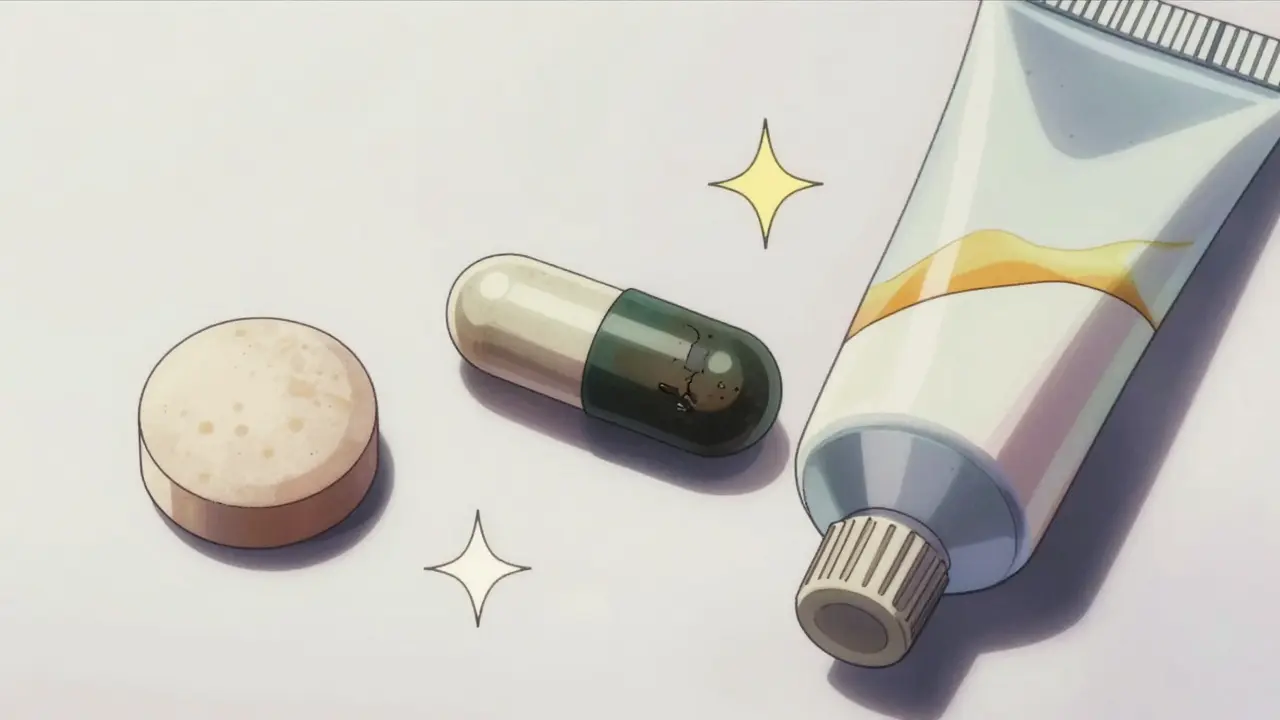
Olfactory Alerts: Smelling Chemical Breakdown
Your nose is a powerful tool for detecting organic decomposition. Many drugs contain volatile compounds that release distinct odors when they break down. While some medications have strong smells naturally, any *change* in that smell is a warning sign.
Pay attention to these specific scents:
- Fishy or Ammonia-like Odors: This often indicates bacterial contamination in liquid suspensions or eye drops. Even if sealed, preservatives lose efficacy over time, allowing microbes to grow.
- Rancid or Sour Smells: Common in lipid-based ointments or suppositories. Fats oxidize and go rancid, much like old cooking oil. This makes the product irritating to skin or mucous membranes.
- Bitter or Metallic Tastes (for oral meds):** If you taste a pill and it seems sharper or more bitter than usual, spit it out. Chemical degradation often increases bitterness as complex molecules break into simpler, harsher compounds.
A real-world example involves morphine sulfate solutions. In one documented case, a hospital continued using expired morphine that had developed fine crystals. The staff mistook the crystallization for normal settling, but the altered chemistry led to adverse patient events. Always rely on multiple senses: if it looks odd, smells off, *and* feels different, it is definitely compromised.
Storage Conditions: Why Your Medicine Cabinet Might Be the Problem
Expiration dates assume ideal storage conditions. Most drugs are tested at 25°C (77°F) with controlled humidity. Your home environment rarely matches this. Heat and moisture are the enemies of pharmaceutical stability.
Stability studies show that temperature fluctuations above 25°C can accelerate physical changes by 2.3 times. Storing aspirin in a bathroom cabinet exposes it to steam from showers, causing it to crumble and lose potency faster. Similarly, leaving insulin in a hot car can denature the protein, rendering it useless even if it hasn't reached its printed expiration date.
To extend the life of your medications:
- Store them in a cool, dry place away from direct sunlight.
- Keep lids tightly closed to prevent moisture ingress.
- Do not store medications in the refrigerator unless explicitly instructed (condensation from repeated opening/closing can damage tablets).
- Use desiccant packets included in blister packs; do not remove them until you take the pill.
If you live in a humid climate like Auckland, New Zealand, consider using airtight containers with silica gel packs for long-term storage of non-refrigerated drugs. This simple step can prevent the caking and clumping seen in hygroscopic antibiotics.
When to Discard vs. When to Consult
Not every slight change means immediate danger, but erring on the side of caution is vital. If a pill has a faint discoloration but is only a few days past its expiration date, it might still be effective. However, if it is months or years old, or shows significant texture changes, discard it.
Never guess with high-risk medications. Insulin, nitroglycerin, liquid antibiotics, and anti-seizure drugs require precise dosing. If there is any doubt about their integrity, consult a pharmacist. They can perform a quick visual assessment and advise whether a replacement is necessary. Remember, the cost of a new prescription is far lower than the cost of treating a failed therapy or an adverse reaction.
Safe Disposal of Expired Medications
Once you identify an expired drug, do not flush it down the toilet unless the label specifically instructs you to do so (this applies to certain highly addictive opioids to prevent misuse). Flushing most medications contaminates water supplies. Instead, use a drug take-back program. Many pharmacies and community centers host collection bins. If none are available, mix the drugs with an unappealing substance like used coffee grounds or cat litter, seal them in a plastic bag, and dispose of them in household trash. Remove all personal information from the prescription label before throwing them away.
Can I use medication that is slightly past its expiration date?
Generally, no. While some stable drugs like acetaminophen may retain potency for a short time after expiration, others like nitroglycerin or insulin degrade quickly and become ineffective or unsafe. The FDA does not guarantee safety or efficacy after the expiration date. If you notice any physical changes, discard it immediately.
Why do my pills smell different than before?
A change in odor often indicates chemical breakdown or microbial contamination. Volatile compounds released during degradation can create fishy, ammonia-like, or rancid smells. This is a strong sign that the medication has spoiled and should not be ingested.
Is it safe to use cream that has separated into layers?
No. Phase separation in creams and ointments means the emulsion has broken. You cannot remix it to restore uniformity. Applying separated cream results in unpredictable dosing-you might get too little medicine or a concentrated dose of irritants. Discard separated topical products.
How does humidity affect medication stability?
Humidity causes tablets to crumble and capsules to cake or stick together. Hygroscopic drugs absorb moisture, leading to chemical reactions that degrade the active ingredient. Store medications in dry places, away from bathrooms and kitchens, to maintain stability.
What is the best way to dispose of expired drugs?
Use a local drug take-back program if available. Otherwise, mix medications with undesirable substances like coffee grounds or cat litter, seal them in a container, and throw them in the trash. Do not flush unless specifically directed, as this harms the environment.
Chris Munton
July 7, 2026 AT 17:44It is truly disheartening to observe the collective negligence regarding pharmaceutical integrity in modern society, a negligence that stems from a fundamental lack of respect for scientific precision and personal responsibility. The degradation of active ingredients is not merely a chemical curiosity but a moral failing when individuals choose convenience over safety, thereby exposing themselves and their communities to preventable harm. One must consider the broader implications of such carelessness, as it reflects a societal drift away from disciplined adherence to established guidelines and towards a chaotic individualism that prioritizes immediate gratification over long-term well-being. The data presented here serves as a stark reminder that our bodies are not playgrounds for experimentation with expired substances, but rather complex systems requiring rigorous maintenance and respect. We must demand higher standards from ourselves and reject the notion that 'close enough' is an acceptable standard when human health is at stake.
Anna Bartle
July 7, 2026 AT 18:55This is incredibly helpful! I always keep my meds in the bathroom because it's convenient, but after reading this, I'm moving them to a drawer in my bedroom immediately! Moisture is definitely the enemy! Thanks for sharing these tips! It really opens your eyes to how much we take for granted about storage conditions!
Amrithaa Thayaparan
July 9, 2026 AT 07:04lol u people r so naive thinking u can just smell ur way out of danger like some primitive animal. real experts know that visual inspection is basic level stuff. the fact that u need an article to tell u not to eat old pills says everything about the decline of common sense in this country. stop relying on government labels and start trusting ur gut or whatever pseudo-science u subscribe to. also why does everyone trust the fda anyway? theyre just another layer of bureaucracy trying to control u.
Katie Dixon
July 10, 2026 AT 23:15I honestly think this whole expiration date thing is a conspiracy by big pharma to make us buy more drugs. But hey, if you want to follow the rules, go ahead. Just remember that true strength comes from ignoring the weak warnings of the establishment. Americans should be proud of their independence, even if it means taking a risk. Don't let anyone tell you what's safe, decide for yourself. That's the American way, right?
Peter Sverla
July 12, 2026 AT 20:05I've been storing my insulin in the fridge for years and never had an issue, but now I'm worried about the condensation part mentioned here. Does anyone else experience this? I usually just leave the door open for a bit before closing it. It seems like a small detail but maybe it matters more than I thought. I'll try keeping it in a cooler bag instead next time.
Sydney Jarrett
July 13, 2026 AT 00:00The pharmacokinetic implications of degraded tetracycline are often underestimated by laypeople who fail to grasp the nephrotoxic potential of epimerization products. It is not merely about efficacy; it is about the accumulation of toxic metabolites that can cause Fanconi syndrome. Furthermore, the phase separation in emulsions represents a breakdown in colloidal stability, leading to unpredictable bioavailability. If you are applying a separated hydrocortisone cream, you are essentially administering a variable dose that could range from subtherapeutic to supratherapeutic, which is clinically irresponsible. Stop treating your medicine cabinet like a junk drawer.
Isis Fleming
July 14, 2026 AT 14:34Thank you for providing such detailed information on this important topic. It is essential that we all take responsibility for our health by properly storing and disposing of medications. I appreciate the clear guidance on visual and olfactory cues. Please continue to share such valuable insights with the community.
Lorena Suarez
July 15, 2026 AT 09:09honestly i just throw everything out when it expires no matter what. its not worth the risk. glad someone wrote this down though because my mom keeps hoarding old pills in her bathroom cabinet. gonna have to talk to her about it soon. thanks for the info
Ben Murphy
July 16, 2026 AT 08:19One cannot overstate the ethical imperative of proper medication disposal. Flushing drugs into the water supply is an act of environmental vandalism that demonstrates a profound disregard for public health and ecological balance. The presence of pharmaceutical residues in aquatic ecosystems disrupts hormonal balances in wildlife and potentially enters the human food chain. Those who choose to flush their medications are acting with a selfishness that borders on criminal negligence. We must hold ourselves accountable to higher standards of civic duty.
Paul Diamond
July 16, 2026 AT 17:29In the grand tapestry of human existence, the decay of our medicines mirrors the inevitable entropy of all things. To inspect a pill is to confront the fleeting nature of order itself. Perhaps the true lesson here is not merely about chemistry, but about acceptance. We cling to our remedies as we cling to life, fearing the moment when they lose their power. Yet, there is wisdom in recognizing when something has served its purpose and must be released. Let us embrace the impermanence of our physical aids with grace.