
How to Verify the FDA Orange Book for Generic Equivalence
 Dec, 21 2025
When a pharmacist hands you a generic pill instead of the brand-name drug your doctor prescribed, you might wonder: Is this really the same thing? The answer isn’t just trust-it’s data. And that data lives in the FDA’s Orange Book. This isn’t some obscure government document. It’s the official, daily-updated database that tells pharmacists, doctors, and insurers whether a generic drug can legally and safely replace the brand version. If you’re verifying generic equivalence-whether you’re a pharmacist, a patient, or just someone trying to understand why your prescription cost dropped-you need to know how to read the Orange Book correctly.
What the FDA Orange Book Actually Is
The FDA’s Approved Drug Products with Therapeutic Equivalence Evaluations-better known as the Orange Book-has been around since 1980. But it became essential after the 1984 Hatch-Waxman Act. That law created a faster, cheaper path for generic drugs to enter the market, as long as they met strict standards. The Orange Book is the rulebook that makes it all work. It lists every FDA-approved drug, brand and generic, and assigns each one a code that tells you whether it’s interchangeable.
It’s not just a list. It’s a decision engine. For over 16,000 prescription drugs, it identifies the original brand product (called the Reference Listed Drug or RLD), lists all approved generics, and gives each a Therapeutic Equivalence (TE) code. These codes are the key. Without them, pharmacists can’t legally substitute. And if you’re relying on a generic to save money, you need to know the code is valid.
The TE Code: Your Secret Decoder Ring
Every drug in the Orange Book has a two-letter TE code. It’s short, but it carries all the weight. Here’s what they mean:
- AB - This is the golden ticket. It means the generic is therapeutically equivalent to the brand. Same active ingredient. Same dosage. Same delivery method. Proven bioequivalent through testing. You can swap it without hesitation.
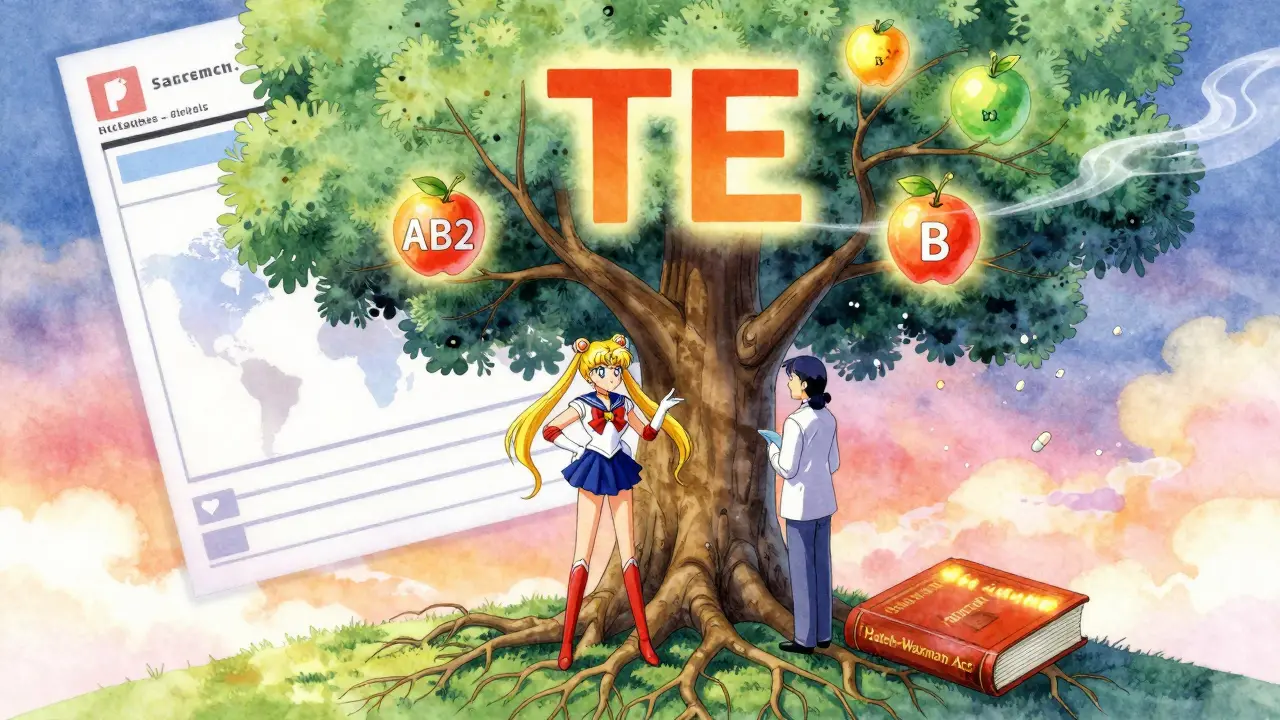
- AB1, AB2, AB3 - These are variations of AB. They exist when there are multiple brand-name versions (RLDs) of the same drug. AB1 means it matches RLD #1. AB2 means it matches RLD #2. Mixing them up can cause problems.
- B - This is a red flag. It means the generic is not considered equivalent. Maybe the bioequivalence data is incomplete. Maybe the formulation causes inconsistent absorption. Don’t substitute these without a doctor’s order.
- BX - A newer category. These are drugs where bioequivalence is suspected but not confirmed. Often used for complex drugs like inhalers or topical creams. Treat them like B-rated products until proven otherwise.
The FDA doesn’t assign these codes lightly. To get an AB rating, a generic must pass five strict tests: approved for safety and effectiveness, identical active ingredients, same dosage form and route, bioequivalent (proven in human studies), properly labeled, and made under strict manufacturing rules. If any one of these fails, the code changes.
How to Search the Electronic Orange Book
The Orange Book is online now-no dusty binders. Go to the FDA’s Electronic Orange Book (it’s free). Here’s how to use it:
- Start with the brand name. Type in the name of the drug you’re replacing-say, Synthroid. Don’t search for the generic yet.
- Find the RLD. The search results will show you the brand-name product. Look for the column labeled “RLD.” It will say “Yes.” That’s your reference point.
- Check the active ingredient. Note the exact name and strength. For Synthroid, it’s levothyroxine sodium 100 mcg.
- Do an ingredient search. Go back to the main search page. Choose “Ingredient” and type in levothyroxine sodium. Filter by dosage form (tablet) and route (oral).
- Look for the TE code. Now you’ll see every approved version. The RLD will still say “Yes.” All the generics say “No.” But what matters is the TE Code column. If it says AB, it’s approved for substitution. If it says B or BX, it’s not.
Pro tip: If you see multiple AB ratings (like AB1 and AB2), make sure the generic you’re considering matches the same RLD as the brand your doctor prescribed. Some states require this match for substitution.

What the Orange Book Doesn’t Tell You
Just because a drug has an AB rating doesn’t mean it’s always interchangeable in practice. The Orange Book tells you what’s scientifically equivalent-not what’s legally allowed.
For example, levothyroxine (used for thyroid conditions) has an AB rating across many generics. But because it’s a narrow therapeutic index drug-small changes in dose can cause big effects-many states require a doctor to specifically authorize substitution. The Orange Book doesn’t flag this. You have to know your state’s pharmacy laws.
Another blind spot: complex drug forms. Inhalers, injectables, and topical creams are harder to prove bioequivalent. Some get BX ratings even if they’re made by the same company as the brand. Pharmacists report confusion here. A 2022 survey found 42% of pharmacists struggle with interpreting TE codes for these products.
Also, the Orange Book doesn’t track discontinued drugs. If a generic is pulled from the market, it disappears from the main list. You’ll only find it in the separate Discontinued Drug Product List. If you can’t find a product in the main search, check there before assuming it’s unavailable.
Third-Party Tools: Helpful, But Risky
Many apps and websites-Drugs.com, IBM Micromedex, GoodRx-pull data from the Orange Book. They’re convenient. But they’re not the source.
The FDA updates the Electronic Orange Book daily. Third-party sites update every 24 to 72 hours. That means a generic might be approved today, but your pharmacy app won’t show it until tomorrow. In a fast-moving situation-like a drug shortage or a new generic hitting the market-that delay matters.
Also, third-party tools sometimes mislabel TE codes or group drugs incorrectly. The FDA warns that relying on them for substitution decisions can lead to errors. Use them for quick checks. Always verify with the official site before making a final call.
Real-World Examples
Let’s say your doctor prescribes Prilosec (omeprazole 20 mg). You want a cheaper generic.
You search the Orange Book for “omeprazole.” You find the RLD is Prilosec. Then you search by ingredient: omeprazole, oral capsule, 20 mg. You see three generics: one with AB1, one with AB2, and one with B.
AB1 and AB2 are both approved. But which RLD do they match? If the AB1 matches the same RLD as Prilosec, it’s safe to substitute. If the AB2 matches a different version of omeprazole-say, one with a different inactive ingredient-you might get a different effect. The FDA says they’re equivalent. But in practice, some patients report differences. That’s why pharmacists often check the RLD match before dispensing.
Another example: Levoxyl vs. generic levothyroxine. Both have AB ratings. But in New York, you need a doctor’s note to switch. In Texas, the pharmacist can swap automatically. The Orange Book doesn’t tell you that. You have to know your state’s rules.
What to Do If You’re Still Confused
The FDA offers free help. Their Drug Info Rounds video series walks you through the Orange Book step by step. They also have a 12-page Quick Reference Guide you can download. And if you’re stuck, email [email protected]. They respond to 95% of questions within two business days.
For pharmacists: spend 15 minutes learning the system. Do five verifications. After that, it becomes second nature. For patients: ask your pharmacist to show you the TE code on the label. If it’s AB, you’re good. If it’s B or BX, ask why.
The system works. Over 90% of prescriptions in the U.S. are filled with generics. That’s thanks to the Orange Book. But only if it’s used correctly.
What’s Next for the Orange Book
The FDA is updating the system for the future. By 2024, it plans to link the Orange Book with the Purple Book (which tracks biologics and biosimilars). That’s important as more complex drugs enter the market. They’re also moving toward machine-readable formats so software can pull data directly-no manual searches needed.
But for now, the manual process still matters. Whether you’re a professional or a patient, knowing how to read the Orange Book means you’re not just trusting a label-you’re understanding the science behind it.
What does an AB rating mean in the FDA Orange Book?
An AB rating means the generic drug is therapeutically equivalent to the brand-name reference drug. It has the same active ingredient, dosage form, strength, and route of administration. It has also passed FDA bioequivalence testing, meaning it delivers the same amount of drug into the bloodstream at the same rate. Pharmacists can legally substitute an AB-rated generic for the brand without needing a doctor’s approval.
Can I substitute any generic with an AB rating for my brand-name drug?
Not always. While an AB rating means the drug is scientifically equivalent, state laws may restrict substitution for certain drugs-especially those with a narrow therapeutic index, like levothyroxine or warfarin. Some states require the prescriber to write "Dispense as Written" or "Do Not Substitute." Always check your state’s pharmacy regulations before assuming substitution is allowed.
Why do some generics have AB1, AB2, or AB3 ratings?
These codes appear when there are multiple brand-name drugs (Reference Listed Drugs or RLDs) for the same active ingredient. Each AB number matches the generic to a specific RLD. For example, AB1 means the generic matches RLD #1. If your doctor prescribed a brand that matches RLD #2, you need a generic with AB2-not AB1-to ensure identical performance. Mixing them can lead to unexpected differences in how the drug works.
Are over-the-counter (OTC) drugs listed in the Orange Book?
OTC drugs are listed in the Orange Book, but they are not assigned therapeutic equivalence (TE) codes. The FDA does not evaluate OTC products for therapeutic equivalence because they are not subject to the same substitution rules as prescription drugs. You can find them in the database, but you won’t see AB or B ratings. Only prescription drugs have TE codes.
Is the FDA Orange Book the only source I need to trust for generic substitution?
The FDA Orange Book is the official and most accurate source for therapeutic equivalence ratings. However, it doesn’t include state-specific substitution laws or discontinued products. Always cross-check with your state’s pharmacy board for legal rules, and check the Discontinued Drug Product List if you can’t find a drug in the main search. Third-party apps may lag behind by up to three days, so never rely on them for final substitution decisions.
Aliyu Sani
December 22, 2025 AT 21:27man, i used to think generics were just cheap knockoffs til i dug into the orange book. AB ratings? that’s the real deal-same active ingredient, same bioequivalence, same damn science. but then you got pharmacists swapping AB1 for AB2 like they’re trading baseball cards and boom-patient gets weird side effects. it’s not just about the code, it’s about the RLD match. if your doc prescribed Synthroid, don’t let ‘em slap you with a generic tied to a different RLD. the orange book’s not magic, it’s a map. you gotta follow the damn route.
Gabriella da Silva Mendes
December 24, 2025 AT 20:51OMG I CANNOT BELIEVE WE STILL HAVE TO DO THIS MANUALLY 😭 Like, we live in 2024 and pharmacists are still googling drug codes like it’s 2003? 🤦♀️ The FDA should just integrate this into every EHR and make it automatic. Why is this still a thing? We have AI that can write sonnets but can’t auto-flag AB vs BX? 🇺🇸 #MakeAmericaPharmaceuticallyEfficient Again
Sai Keerthan Reddy Proddatoori
December 26, 2025 AT 05:35they say AB means safe. but who really controls the labs? i seen news-some generics made in china have different fillers. same pill, different soul. orange book? it’s a government lie. they don’t test every batch. they test one. then they stamp AB and call it good. you think your thyroid med is the same? think again. your body knows. you feel it. they just don’t wanna admit it.
Johnnie R. Bailey
December 27, 2025 AT 13:12the orange book is the unsung hero of american healthcare. nobody talks about it, but it’s the reason you pay $4 for lisinopril instead of $200. here’s the thing most miss: AB doesn’t mean ‘identical.’ it means ‘functionally equivalent within statistically acceptable margins.’ that’s science, not magic. and yeah, for narrow-therapeutic-index drugs like levothyroxine, the margins are razor-thin. that’s why some docs still say ‘do not substitute’-not because the science is wrong, but because human biology isn’t a spreadsheet. respect the code, but know its limits.
Tony Du bled
December 27, 2025 AT 22:13so if it says AB, just take it. no drama. my pharmacist swaps mine every time and i’ve never had an issue. maybe it’s because i don’t overthink it.
Kathryn Weymouth
December 27, 2025 AT 22:52the distinction between AB1, AB2, and AB3 is critically undercommunicated. many patients assume all AB-rated generics are interchangeable, but the RLD alignment matters-especially for drugs with multiple originators. the FDA’s documentation is technically accurate, but the lack of standardized patient-facing explanations creates confusion. a simple visual guide on the search results page-showing RLD lineage-would prevent countless medication errors.
Herman Rousseau
December 28, 2025 AT 13:18you guys are overcomplicating this. the orange book exists so you don’t have to be a pharmacist to know if your generic is legit. if it’s AB, it’s good. if it’s B, ask. if it’s BX, be cautious. and if you’re still worried? call your pharmacist. they’re trained to read this stuff. the system works. 90% of prescriptions are generics for a reason. trust the data, not the fear. 🙌
Vikrant Sura
December 28, 2025 AT 16:24why are we even talking about this? the orange book is a corporate tool. big pharma controls what gets approved. generics aren’t cheaper-they’re just less tested. if you want real safety, stick with brand. it’s not about equivalence, it’s about profit.