
Language Access for Medication Counseling: Understanding Your Interpreter Rights
 Apr, 24 2026
Pharmacy Language Access Rights Checker
Use this checklist to evaluate if your pharmacy is providing the legal language services you are entitled to. Select the services you have been offered or have seen at the pharmacy.
Pending...
At its core, Language Access is a set of legally mandated services that ensure people who aren't fluent in English get accurate pharmaceutical information in their preferred language
. Whether it's through a professional interpreter or translated labels, these rights are designed to make sure every patient knows exactly how to use their medication safely. If you or a loved one are navigating the healthcare system and struggle with English, you have a legal right to "meaningful access" to your care.The Legal Shield: ACA Section 1557 and State Laws
The foundation of these rights is Section 1557 of the Affordable Care Act (or ACA Section 1557), which is a federal civil rights law prohibiting discrimination in healthcare based on race, color, national origin, sex, age, or disability ]. While the ACA provides a federal baseline, some states have stepped up the requirements. For instance, New York's SafeRx regulations (EDN 6829) are among the strictest in the U.S., mandating that pharmacies provide interpretation services immediately.
One of the most critical updates happened on July 5, 2024. The strengthened ACA rules now explicitly prohibit healthcare providers from forcing LEP patients to bring in family members or children to act as interpreters. While you can request a family member help you, the pharmacy cannot make it a requirement. This protects patient privacy and prevents the medical errors that often happen when a child or relative tries to translate complex medical jargon.
What Specifically Are You Entitled To?
When you visit a pharmacy that receives federal funding, your rights aren't vague-they are concrete. You shouldn't have to struggle through a conversation using hand gestures. Here is exactly what a compliant pharmacy should provide:
- Free Oral Interpretation: You have the right to a qualified interpreter for your medication counseling. This doesn't always mean someone standing next to you; many pharmacies use high-quality phone or video services to connect you with a professional in real-time.
- Translated Labels: Your primary prescription labels and warning labels (like "May cause drowsiness") should be available in your language.
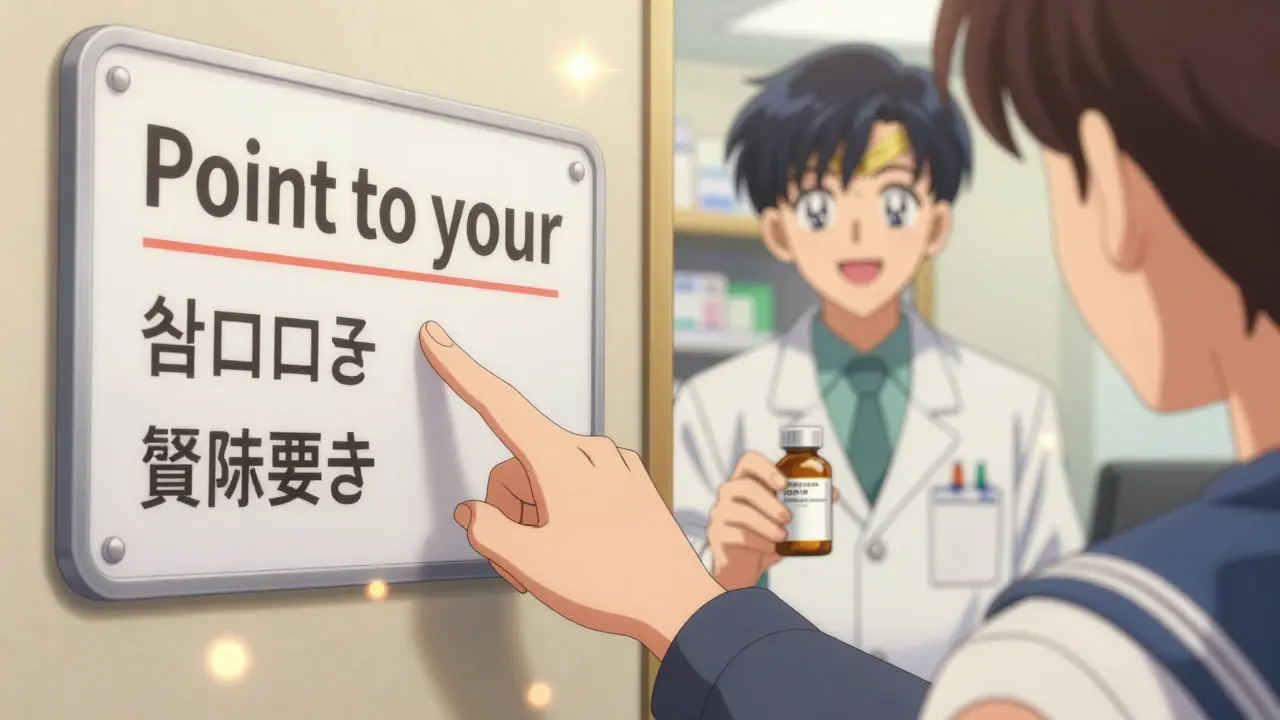
- Clear Signage: Look for the "Point to your language" signs near the counter. These are designed to let you request help without needing to speak English first.
- Qualified Professionals: The person interpreting shouldn't just be a bilingual staff member who knows a few words. A "qualified interpreter" is someone proficient in both English and your language, specifically trained in medical and pharmaceutical terminology.
| Requirement | Federal (ACA 1557) | New York (SafeRx) | Other States (e.g., TX, FL) |
|---|---|---|---|
| Scope | All federally funded providers | Pharmacy-specific mandates | Mostly hospital-focused |
| Auxiliary Labels | General guidance | Mandatory translation | Rarely required |
| Signage | Required (general) | Specific "Point to your language" | Varies by facility |
| Family Interpreters | Prohibited as a requirement | Prohibited as a requirement | Often still common practice |

Why These Rights Are a Matter of Life and Death
This isn't just about convenience or politeness; it's a safety plan for your health. When a patient doesn't understand their instructions, the results can be catastrophic. Research by Dr. Lisa M. Weiss and colleagues highlighted that inadequate comprehension is a primary driver of adverse drug events. If you don't know a medication must be taken on an empty stomach, or that it interacts dangerously with alcohol, you are at risk.
The numbers back this up. The American Pharmacists Association noted a 67% reduction in medication errors when professional interpreters were used instead of ad-hoc helpers. In New York City, there was a 28% drop in medication-related emergency room visits among LEP patients after these language access laws were enforced. By ensuring you understand the what, when, and how of your medicine, these laws effectively lower the risk of accidental poisoning or treatment failure.
How Pharmacies Implement These Services
You might wonder how a small pharmacy manages to support dozens of different languages. Most use a tiered system. For the most common languages in a specific area (determined by U.S. Census data), they may have staff who are fluent or pre-translated materials. For less common languages, they rely on professional services like LanguageLine Solutions, which is a global interpretation service that provides on-demand telephonic and video interpretation ].
A compliant pharmacy follows a specific workflow to ensure no one slips through the cracks:
- Identification: They use intake questionnaires or the "Point to your language" signs to identify the patient's preference.
- Profile Documentation: Your language preference is recorded in your permanent medication profile so every future pharmacist knows your needs.
- Service Delivery: They connect a qualified interpreter via phone or video for the counseling session.
- Verification: The pharmacist ensures the patient can repeat back the instructions to confirm understanding.
Common Hurdles and What to Do if Your Rights Are Ignored
Despite the laws, the reality on the ground isn't always perfect. Some independent pharmacies struggle with the cost of these services, and some staff members may not be properly trained on how to trigger the interpretation system. You might find a pharmacy that has the required signs but no one who knows how to actually call the interpreter.
If you are denied an interpreter or told you must bring your own, you have options. You can ask for the pharmacy manager to provide a "qualified interpreter" as required by the ACA. If the issue persists, you can contact the New York State Office of Language Access Services or the federally-funded Language Access Help Desk. Documentation is key-if you feel your rights are being violated, note the date, the time, and exactly what was said. This helps regulatory bodies like the State Attorney General's office hold providers accountable.
Does the pharmacy have to provide the interpreter for free?
Yes. Under federal law and state regulations like those in New York, oral interpretation services for medication counseling must be provided at no cost to the patient.
Can the pharmacist just use Google Translate?
While AI tools are becoming more common, current regulations require "qualified interpreters" for medication instructions. This means a human who understands medical terminology to ensure there are no dangerous mistranslations.
What if I prefer my daughter to translate for me?
You are always allowed to use a family member if you prefer. However, the pharmacy cannot force you to do so; they must offer a professional service if you need one.
How many languages must a pharmacy support?
In New York, pharmacies must provide services for "primary languages" spoken by 1% or more of the population in that region, up to a maximum of seven languages per region.
Are translated labels required for all medications?
In highly regulated areas like New York, pharmacies are required to translate both the primary prescription label and the auxiliary warning labels (e.g., "Take with food").
Next Steps for Patients and Caregivers
If you are advocating for a family member, start by checking the pharmacy's signage. If you don't see the "Point to your language" prompts, it may be a sign that the pharmacy isn't fully compliant. When filling a new prescription, explicitly state the language preference during the intake process. Don't be afraid to ask the pharmacist, "Can I have a qualified interpreter for my counseling session?" This simple question triggers the legal requirement and ensures the safety of the medication process.
Carol Yang
April 26, 2026 AT 09:03This is such a helpful reminder for anyone who might be struggling to get the care they need!
Edwin Perez
April 28, 2026 AT 07:43Sure, let's just trust the "qualified professionals" hired by the same corporate machine that profits off the pills in the first place. It is all just a layer of bureaucracy to make it look like they care while they keep the data flowing into some government database about who speaks what language.
Sharyl Foster
April 30, 2026 AT 02:01People act like this is some revolutionary legal shield but it's basically just common sense. Like, why do we even need a law to tell a pharmacist not to let a six-year-old translate a heart medication dose? Just use a phone. It's not that deep.
Andre Ojakäär
May 1, 2026 AT 11:38absolutely insane that people still do this without a professional translator... like seriously... one wrong word and boom... hospital trip... total madness
Majestic Blue Band
May 2, 2026 AT 13:24It is absolutely fascinating how we are told that these "point to your language" signs are for our safety, but in reality, they are just a way for the state to categorize and track non-native speakers into specific demographics, which honestly fits perfectly into the larger narrative of social control and surveillance that has been escalating for decades, and I bet you anything that these "interpretation services" are just recording every single interaction to build a psychological profile of immigrant communities under the guise of medical necessity, which is just typical of the way the system operates to maintain a facade of empathy while stripping away actual privacy and autonomy in the most insidious ways possible.
Jon Moss
May 3, 2026 AT 13:53I've seen so many people struggle at the counter just because they're too shy to ask for this. It's a relief that it's a legal right.
Hayley Redemption
May 4, 2026 AT 10:58The anecdotal evidence is fine, but the actual systemic failure here is the cost-benefit analysis pharmacies perform. They'll tick the box for compliance to avoid a lawsuit, but the quality of the "qualified" interpretation is often abysmal. If you actually analyze the delta between federal requirements and state-level execution, it's a joke.
Vijay AGarwal
May 5, 2026 AT 14:50This is an absolute catastrophe of a situation when it fails! We are talking about human lives! A single mistranslated word regarding a dosage can lead to a fatal outcome, which is a nightmare scenario for any healthcare provider! The urgency of implementing these laws globally cannot be overstated because the risk of medical error is a ticking time bomb in any multilingual society!
suresh kumar
May 7, 2026 AT 04:04This whole thing is a fancy way of saying some folks can't talk to the druggist. Just get a neighbor who speaks both and call it a day, why make it such a big deal with all these fancy laws and signs?
Karyn Tindall
May 8, 2026 AT 21:52Actually, the point about children translating is so critical! It puts an unfair emotional burden on the child and it's just wrong to expect a kid to handle that kind of responsibility!
Beena Garud
May 9, 2026 AT 06:09The intersection of linguistic accessibility and the fundamental right to health is a profound ethical imperative that transcends simple legal compliance.
sachin singh
May 9, 2026 AT 10:27The mention of the 67% reduction in errors is quite impressive. It demonstrates that systemic changes in communication directly correlate with improved patient outcomes.