
Medicaid Generic Drug Coverage: State-by-State Rules and Requirements in 2026
 Feb, 13 2026
When you’re on Medicaid, getting your prescriptions filled shouldn’t be a maze. But for millions of Americans, it is. The federal government sets the floor for what Medicaid must cover-but every state builds its own house on top of that floor. And that means your ability to get a generic drug, how much you pay, and even whether your pharmacist can swap it out without asking your doctor all depend on where you live.
Why Medicaid Covers Generics (And Why It Matters)
Generic drugs make up over 84% of all Medicaid prescription claims. That’s not because they’re less effective-it’s because they’re cheaper. In 2024, Medicaid spent $38.7 billion on generics, which sounds like a lot, but it’s only 28% of total pharmacy spending because those same generics filled 85% of all prescriptions. The math is simple: if you cut the cost of pills, you can cover more people. That’s why every state covers outpatient drugs-even though federal law technically lets them opt out.
But here’s the twist: just because a drug is generic doesn’t mean it’s always easy to get. Some states put up roadblocks. Others make it almost automatic. The difference isn’t just policy-it’s health outcomes.
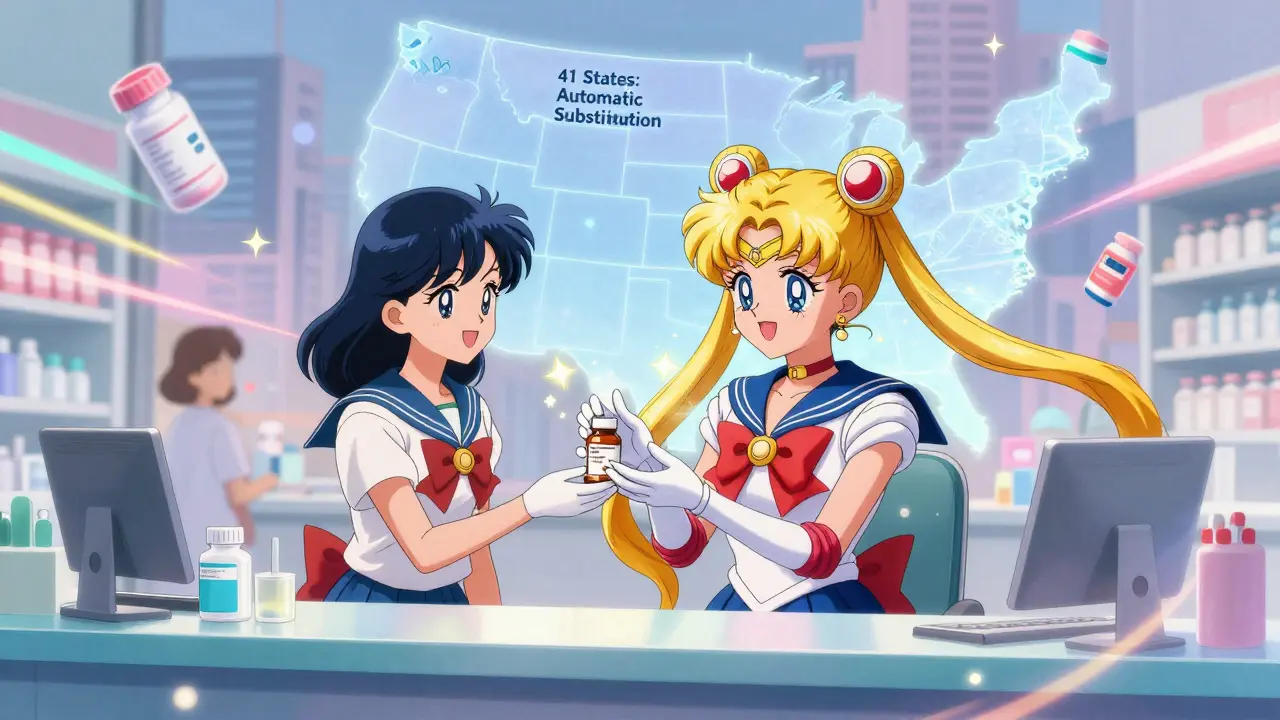
Automatic Generic Substitution: 41 States Make the Switch for You
Let’s say your doctor prescribes a brand-name blood pressure pill. In 41 states, your pharmacist can swap it for the generic version without asking anyone. That’s called automatic generic substitution. It’s built into state law, and it’s designed to save money and reduce confusion.
Colorado, for example, requires substitution unless the patient has been stable on the brand name for months, or the generic costs more than the brand (yes, that happens sometimes). Other states like New York and Illinois have similar rules. But in 9 states, pharmacists need permission from the prescriber before switching-even if the generic is identical, FDA-approved, and cheaper.
Why does this matter? A 2024 University of Pennsylvania study found that when patients had to wait for approval to switch meds, hospital admissions jumped 12.7%. That’s not just a cost issue-it’s a safety issue.
Formularies: How States Sort Your Drugs Into Tiers
Every state Medicaid program uses a formulary-a list of approved drugs. But not all lists are created equal.
Most states use a tiered system:
- Tier 1: Preferred generics (lowest cost, no prior auth)
- Tier 2: Non-preferred generics or brand-name drugs (higher cost, may need approval)
- Tier 3: Specialty drugs (often require step therapy or prior auth)
CVS Caremark, which runs pharmacy benefits for 14 states, uses this structure. But states tweak it. In California’s Medi-Cal program, over 90% of generics are in Tier 1. In Texas, nearly half of generic drugs are in Tier 2 or higher, meaning higher copays or extra steps.
Some states even have “value-based” lists-drugs that save money without hurting outcomes. Michigan started one for diabetes meds and cut costs by 11.2% while keeping adherence steady. Only 9 states have tried this so far. But it’s catching on.
Copays: From $0 to $8-It Depends on Your State
How much do you pay at the pharmacy counter? That’s up to your state. Federal rules let states charge up to $8 for non-preferred generics if your income is below 150% of the poverty line. But many states charge less-or nothing at all.
Here’s how it breaks down:
- $0 copay: 16 states, including New York, Washington, and Minnesota
- $1-$3: 22 states, like Florida, Georgia, and Oregon
- $4-$8: 12 states, including Texas, North Carolina, and Alabama
Some states waive copays entirely for certain groups-like pregnant women, kids under 18, or people with chronic conditions. But if you’re an adult with no other coverage, you might be stuck paying more than you expected.

Prior Authorization: The Hidden Bureaucracy
Even if a drug is on the formulary, you might still need approval. That’s prior authorization. And it’s where things get messy.
Colorado’s Health First Colorado program requires it for almost all non-preferred drugs. For opioids? You can’t get more than 7 days’ supply on your first prescription, and no more than 8 pills per day after that. For certain GI meds? You have to try three preferred NSAIDs and three proton pump inhibitors first.
Meanwhile, California’s Medi-Cal rarely requires prior auth for generics. The difference? In Colorado, providers spend an average of 17 minutes per patient just filling out forms. In California? Closer to 6 minutes.
The American Medical Association says primary care doctors waste $8,200 a year per provider just handling prior auth for generics. That’s time that could be spent on real care.
Therapeutic Interchange: When Pharmacists Can Swap Even Without a Prescription
In 17 states, pharmacists don’t just substitute generics-they can switch you to a different generic entirely if it’s cheaper. That’s called therapeutic interchange.
For example: if your doctor prescribes one generic version of metformin, your pharmacist can give you another generic version if it’s $10 cheaper and just as effective. This is allowed in states like Ohio, Illinois, and Maryland.
But 28 states require the pharmacist to notify the doctor before making the switch. And 12 states let the pharmacist decide alone-no notice needed. That inconsistency means you might get a different pill depending on which pharmacy you walk into-even if you live next door to someone who got a different one.
What’s Changing in 2026?
Two big things are coming down the pipe.
First, the federal government is pushing states to cover anti-obesity drugs like Wegovy and Ozempic under Medicaid. If finalized, this could affect 4.7 million people. But states aren’t happy. They say they can’t afford it without more federal funding. The National Association of Medicaid Directors warned that this could force cuts elsewhere.
Second, Congress is considering a bill that would stop generic drugs from getting inflation-based rebates from drugmakers. Right now, when drug prices go up, manufacturers pay back a portion to Medicaid. If that changes, states could lose $1.2 billion a year. That could mean higher copays, stricter formularies, or even reduced coverage.
And then there’s the quiet shift: more people are getting both Medicaid and Medicare. Starting in 2025, those folks can switch their drug plans once a month. That means pharmacists and doctors have to juggle two systems at once. More confusion. More errors.
Who’s Getting Left Behind?
It’s not just about policy-it’s about access.
In Vermont, 98% of community pharmacies accept Medicaid. In Texas, it’s only 67%. Why? Reimbursement rates. If the state pays too little, pharmacies don’t want to participate. That means rural patients drive 40 miles just to fill a prescription.
And then there’s documentation. Massachusetts scored 4.6 out of 5 for how clear its formulary rules are. Mississippi? 2.8. Doctors in Mississippi spend 30% more time on paperwork just to figure out what’s covered.
The result? People stop taking their meds. Studies show that when patients hit a wall with prior auth or copays, they skip doses. And that leads to ER visits, hospital stays, and higher costs in the long run.
What You Can Do
If you’re on Medicaid:
- Ask your pharmacist: "Is this the preferred generic?"
- Request a copy of your state’s formulary-most are online
- If you’re denied, ask about an exception process-many states allow appeals
- Check if your state has a therapeutic interchange policy
- Call your state Medicaid office if your pharmacy refuses to fill a generic that should be covered
Knowledge is power. The system is complex, but you’re not powerless.
Do all states cover generic drugs under Medicaid?
Yes. All 50 states and Washington, D.C., cover outpatient prescription drugs-including generics-for all categorically eligible Medicaid enrollees. Federal law doesn’t require it, but every state has chosen to include it because generics save money and improve access.
Can my pharmacist switch my brand-name drug to a generic without my doctor’s permission?
In 41 states, yes. These states have laws allowing automatic generic substitution if the drug is therapeutically equivalent. But in 9 states, the pharmacist must get approval from your doctor first-even if the generic is cheaper and FDA-approved.
How much can Medicaid charge me for a generic drug?
Federal rules allow states to charge up to $8 for non-preferred generics if your income is below 150% of the federal poverty level. But 16 states charge $0, and 22 charge $1-$3. Only 12 states charge the full $8. Copays are often waived for children, pregnant women, and people with chronic conditions.
Why do some states require prior authorization for generic drugs?
Prior authorization is used to control costs and prevent overuse. Some states require it for non-preferred generics, especially if they’re expensive or used for conditions like pain, mental health, or obesity. Colorado, for example, requires it for most non-preferred drugs and limits opioid prescriptions to 7 days for first-time users.
Are there states where pharmacists can switch me to a different generic without telling my doctor?
Yes. In 12 states, pharmacists can substitute one generic for another without notifying the prescriber. In 28 states, they must notify the doctor. And in 17 states, they can even switch to a different therapeutic class if it’s cheaper and equally effective-this is called therapeutic interchange.
Will Medicaid start covering weight-loss drugs like Ozempic?
The Centers for Medicare & Medicaid Services proposed a rule in late 2024 that would require states to cover anti-obesity medications under Medicaid. If finalized, it would affect nearly 5 million beneficiaries. But many states oppose it, saying they can’t afford it without more federal funding. The rule is still under review as of early 2026.
What happens if my state stops covering a generic drug?
If a drug is removed from the formulary, you may be able to get an exception. You or your doctor can file an appeal, often with supporting medical evidence. Some states allow temporary coverage while the appeal is reviewed. But if denied, you’ll need to pay out-of-pocket, switch to another drug, or go without.
What’s Next?
The system is under pressure. Drug prices for some generics have gone up, not down. Supply chain issues have caused shortages of critical medications. And with more people getting dual coverage (Medicaid + Medicare), the confusion is growing.
But there’s hope. States that simplify rules, reduce prior auth, and raise reimbursement rates see better outcomes. Patients take their meds. ER visits drop. Costs go down.
The future of Medicaid generic coverage won’t be decided in Washington. It’ll be decided in statehouses, pharmacies, and doctor’s offices across the country. And if you know your rights, you can help shape it.
Joanne Tan
February 13, 2026 AT 20:38just wanted to say this post is a lifesaver 🙌 i was struggling to figure out why my pharmacist kept giving me different generics and now i get it-some states let them swap freely, others make it a nightmare. thanks for laying this out so clearly!
Kristin Jarecki
February 15, 2026 AT 07:55Thank you for this comprehensive and meticulously researched overview. The data presented-particularly regarding the 12.7% increase in hospital admissions due to delayed generic substitution-is compelling and underscores the necessity of policy standardization. It is imperative that state Medicaid programs prioritize patient safety over administrative convenience.
Jonathan Noe
February 16, 2026 AT 07:44yo i read this whole thing and honestly? the real problem isn’t the states-it’s the damn pharma companies. they’re the ones who jack up prices on generics then turn around and give rebates to states so they can look like heroes. it’s a shell game. and now they want to kill the inflation rebates? that’s not reform, that’s theft. also, 9 states still make pharmacists call doctors? are you kidding me? we have smartphones. just text the damn script.
Sophia Nelson
February 16, 2026 AT 08:26this post is just a marketing brochure for pharmacy benefit managers. no one talks about how states use formularies to ration care under the guise of 'cost savings.' you think tiered systems are about efficiency? they’re about denying access. and don’t even get me started on 'therapeutic interchange'-that’s just pharmacy greed in a lab coat. also, why is no one mentioning the 2023 study showing 37% of generic switches led to adverse reactions? oh right, because this article doesn’t want you to know.
Robert Petersen
February 17, 2026 AT 01:14big thank you for breaking this down-it’s overwhelming out there. i’ve been helping my mom navigate her meds and this made it way less scary. i didn’t know about therapeutic interchange in Illinois, but now that i do, i’m calling her pharmacist tomorrow to see if she can save $15/month. small wins matter. keep this kind of info coming!
Alyssa Williams
February 18, 2026 AT 23:54just got off the phone with my state medicaid office and they said i can appeal a denied generic if it’s on the formulary but they denied it anyway. turns out the pharmacy said it was 'non-preferred' but the state website says it’s tier 1. so who’s lying? i’m done with this system. if you’re on medicaid you’re already treated like a second-class citizen. this post helped me realize it’s not me-it’s the whole damn setup.
Ernie Simsek
February 20, 2026 AT 20:54bro i just spent 45 mins on hold trying to get my metformin refilled and they said 'we need prior auth' but the drug is generic?? 😭 the system is rigged. also i saw a pharmacist swap my pill for a different generic without saying a word and now i have diarrhea. thanks, america 🤡
Carla McKinney
February 20, 2026 AT 23:06the author conveniently omits the fact that automatic substitution increases medication errors. studies show that patients on multiple generics are 3x more likely to experience adverse interactions when pharmacists swap without consultation. this isn't 'efficiency'-it's negligence disguised as policy. also, why are you praising therapeutic interchange? that’s not innovation, that’s pharmaceutical roulette.
Robert Petersen
February 21, 2026 AT 20:12to the person above: i get your concern, but the data doesn’t back that up. the 2024 Penn study specifically looked at error rates and found no increase in adverse events when substitution was automatic-only when it was delayed. and therapeutic interchange? it’s only allowed if the drugs are bioequivalent. we’re not talking random swaps. we’re talking FDA-approved, same active ingredient, same dose. it’s not roulette, it’s math. and if your state doesn’t allow it, maybe push for it.