
Taking Prescription Medicine with Food vs. on an Empty Stomach: What You Really Need to Know
 Dec, 8 2025
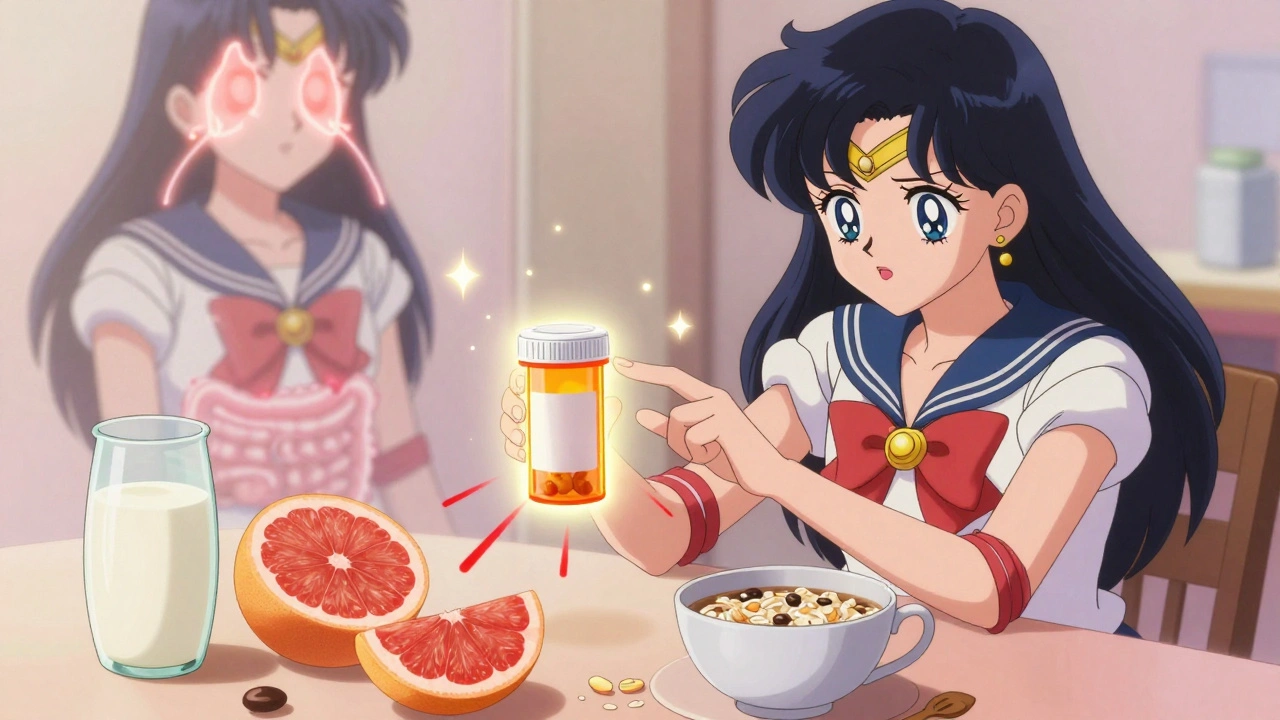
Have you ever looked at your prescription label and seen those tiny words: "Take on an empty stomach" or "Take with food"? You might’ve shrugged it off, thinking it’s just a formality. But here’s the truth: getting this wrong can make your medicine less effective-or even dangerous.
It’s not about being perfect. It’s about understanding why your doctor or pharmacist gave you that instruction. And the answer isn’t just "it helps absorption." It’s about stomach acid, fat content, timing, and even your gut bacteria.
Why Food Changes How Your Medicine Works
Your digestive system isn’t just a pipe for food. It’s a chemical factory. When you eat, your body releases acid, bile, and enzymes. Blood flow shifts. Your stomach empties slower. All of that changes how your medicine gets into your bloodstream.
Some drugs need acid to dissolve. If you take them after a big meal, your stomach pH rises, and the drug might not break down at all. That’s why antibiotics like tetracycline and doxycycline lose up to 50% of their effectiveness if taken with dairy, calcium supplements, or even antacids. The calcium binds to the drug and pulls it out of circulation before it can do its job.
On the flip side, some drugs need fat to be absorbed. Take saquinavir, an HIV medication. A high-fat meal can boost its absorption by up to 40%. That’s not a small difference-it’s the difference between controlling the virus and risking resistance. Grapefruit juice does something similar: it blocks an enzyme in your gut that breaks down certain drugs, making them stronger. But that’s risky. Too much can lead to overdose.
Food also slows down how fast your stomach empties. That’s good for some drugs-like levothyroxine, used for hypothyroidism. If you take it with breakfast, your body absorbs 20% to 55% less. That means your thyroid levels stay low, and you keep feeling tired, cold, and sluggish. Taking it 30 to 60 minutes before food? That’s when it works best.
Medicines That Need Food
Not all drugs are created equal. Some actually cause harm if taken on an empty stomach.
NSAIDs like ibuprofen, naproxen, and aspirin are classic examples. They irritate the stomach lining. Taking them without food increases your risk of ulcers and bleeding. The UK’s NHS and German medical guidelines both recommend taking these after eating. One study found that taking ibuprofen with food cuts nausea by 20%. And while some older research questioned whether food really helps with pain relief, most doctors still advise food-not because it makes the drug work better, but because it protects your gut.
Some antibiotics also need food to be tolerable. Augmentin (amoxicillin/clavulanate) causes nausea in about 30% of people on an empty stomach. With food, that drops to 10%. Same goes for nitrofurantoin and rifabutin. Food doesn’t make them stronger-it just makes them easier to take. And if you can’t swallow the pill without vomiting, you’re not getting the full dose.
Antiretrovirals like ritonavir and zidovudine are another group. HIV patients often report severe nausea when taking these on an empty stomach. A Reddit community of over 120 patients reported that taking ritonavir with a small high-fat snack-like peanut butter or cheese-cut nausea from 45% down to 18%. That’s life-changing for someone managing daily meds.
Medicines That Must Be Taken on an Empty Stomach
Some drugs are like delicate flowers. They die if they touch food.
Levothyroxine is the most common. Studies show even a bowl of oatmeal can reduce absorption by over half. That’s why the standard advice is: take it first thing in the morning, with a full glass of water, and wait 30 to 60 minutes before eating. Some people even take it at bedtime-12 hours after their last meal-to avoid interference.
Didanosine, another HIV drug, is destroyed by stomach acid. Food increases acid production, so it must be taken on an empty stomach. The same goes for alendronate (a bone drug). You have to wait 30 minutes after taking it before eating or drinking anything except water. Otherwise, it won’t reach your bones.
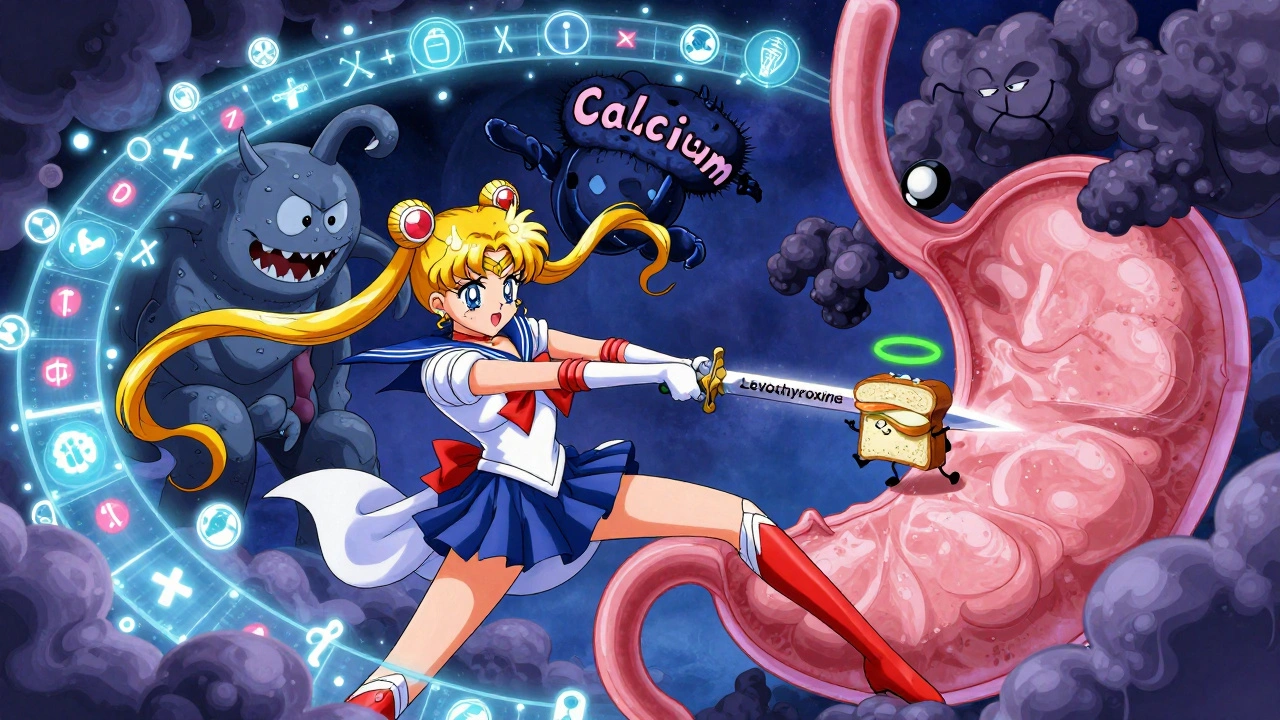
Tetracycline and doxycycline are also sensitive. Calcium, iron, magnesium, and even antacids can lock onto them and stop them from working. That means no dairy, no calcium supplements, no Tums-within two hours before or after the dose.
And then there’s the timing. The Mayo Clinic says: if your medicine says "empty stomach," take it one hour before a meal or two hours after. That’s the buffer zone. Don’t guess. Use a phone alarm if you have to.
What About Grapefruit, Coffee, or Alcohol?
Food isn’t just meals. It’s drinks, too.
Grapefruit juice is infamous. It blocks an enzyme called CYP3A4 that breaks down over 85 drugs. That includes some statins, blood pressure meds, and immunosuppressants. One glass can make your drug levels spike dangerously. Even a small amount can last 24 hours. So if your label doesn’t say "avoid grapefruit," assume it’s unsafe unless confirmed by your pharmacist.
Coffee isn’t as bad, but it can interfere with thyroid meds and some antibiotics. Wait at least 30 minutes after taking your pill before your morning cup.
Alcohol is another silent killer. It can boost the sedative effects of painkillers, anxiety meds, and sleep aids. It can also damage your liver when mixed with acetaminophen or certain antibiotics. If your label doesn’t mention alcohol, ask. Don’t assume it’s fine.
How to Actually Remember All This
Most people manage 3 to 5 medications. Some have 10 or more. Keeping track of which one needs food, which needs an empty stomach, which needs a high-fat snack, and which needs to wait 60 minutes? It’s overwhelming.
A 2023 survey found 42% of patients admit to taking meds incorrectly regarding food. The worst offenders? People on five or more drugs.
Here’s what works:
- Use color-coded labels. Pharmacists in New Zealand and the U.S. have started using red for "empty stomach," green for "with food," and yellow for "with high-fat meal." Patients who used these had 31% better adherence.
- Set phone alarms. One Reddit user said they set three alarms: "Take levothyroxine," "Eat breakfast," and "Take ibuprofen." They went from forgetting 3 times a week to zero.
- Ask your pharmacist. A 2024 report showed patients who got a 5-minute talk from their pharmacist about food interactions had 27% higher adherence. Don’t just pick up the script-ask.
- Use a pill organizer with notes. Write "with food" or "30 min before" on each compartment. Visual cues stick better than memory.
And here’s the secret: knowing why matters more than just following instructions. When patients understand that food can block absorption or cause nausea, they’re 44% more likely to stick to the rules. It’s not about obedience. It’s about control.
What’s Changing in 2025
The rules are getting more precise. The FDA’s 2024 draft guidance now requires drug labels to say more than just "with food." They need to specify: "Take with a high-fat meal," or "Avoid dairy within 2 hours." That’s a big shift.
Researchers at UCSF are testing a machine learning tool that predicts how your gut microbiome affects drug absorption. In early trials, it was 87% accurate. Imagine a future where your app tells you: "Your gut bacteria slow down this drug-take it with avocado, not toast."
And the WHO added specific food instructions to its Essential Medicines List-especially for HIV and TB drugs in low-income countries. Because if you’re choosing between food and medicine, you need to know which one to eat first.
Bottom Line: Follow the Label, But Understand It
There’s no universal rule. Some meds need food. Some need to be alone. Some need fat. Some need water. Some need silence-no coffee, no grapefruit, no alcohol.
Don’t rely on memory. Don’t assume it’s "probably fine." If your label says "on an empty stomach," take it seriously. If it says "with food," don’t skip the peanut butter.
Your medicine works best when you work with your body-not against it. And that starts with paying attention to the tiny print.
Sarah Gray
December 8, 2025 AT 12:06Let’s be real-most people don’t read the label because they assume it’s just corporate legalese. But the difference between taking levothyroxine with oatmeal versus on an empty stomach isn’t ‘kinda less effective’-it’s a 55% drop in bioavailability. That’s not a suggestion. That’s a pharmacokinetic disaster waiting to happen. And no, ‘I’ve been doing it wrong for years and I’m fine’ isn’t evidence-it’s survivorship bias wrapped in denial.
Pharmacists aren’t just pill dispensers. They’re clinical gatekeepers. If you’re on more than three meds, you owe it to yourself to schedule a med-reconciliation visit. Not a ‘quick question’ at the pickup window. A real 15-minute consult. With notes.
Also-grapefruit juice isn’t ‘kinda risky.’ It’s a CYP3A4 inhibitor that can turn a 10mg dose into a 50mg spike. That’s not ‘I had a glass.’ That’s ‘I just overdosed on my blood pressure med.’ Stop romanticizing citrus.
And yes, I’ve seen patients end up in the ER over this. It’s not a myth. It’s a documented, preventable catastrophe. Read the fine print. Or don’t. But don’t act surprised when your body rebels.
And if you think ‘I’ll just take it with food because it’s easier’-you’re not saving time. You’re gambling with your health. And that’s not bravery. It’s negligence dressed as convenience.
Michael Robinson
December 9, 2025 AT 22:00Food and medicine don’t mix like oil and water. They mix like fire and gasoline. Sometimes it makes the flame bigger. Sometimes it puts it out. You don’t need a PhD to get that. You just need to care enough to read the tiny words.
It’s not about being perfect. It’s about being aware. Your body isn’t a machine. It’s a living thing. And it reacts. Always.
So if the label says ‘empty stomach,’ don’t eat first. If it says ‘with food,’ eat something. Simple. No magic. Just respect.
Kathy Haverly
December 10, 2025 AT 09:28Oh great. Another ‘follow the label’ sermon from someone who probably takes their levothyroxine with a 12-step ritual and a crystal singing bowl.
Let me guess-you also wash your hands with distilled water before touching your pills, right? And you time your ibuprofen to the minute because ‘the stomach lining is sacred’? How quaint.
Most people don’t die from taking meds with food. They die from heart disease, stress, and poverty. But sure, let’s pretend that forgetting to wait 30 minutes after breakfast is the real public health crisis.
And don’t get me started on ‘high-fat meal’ for HIV meds. You think people in rural India are sitting down to avocado toast before their ARVs? Or are they just eating whatever they can to survive? This is performative medicine for people who have too much time and too little real suffering.
Stop shaming people for being human. The system’s broken. Don’t blame the patients.
Andrea DeWinter
December 10, 2025 AT 17:49I used to be the person who took everything with breakfast because it was just easier. Then I got prescribed rifabutin and spent a week vomiting every morning. My pharmacist sat me down and said ‘this isn’t about willpower, it’s about chemistry.’
So I started taking it with a spoonful of peanut butter. No more nausea. No more missed doses. Just a snack and a little patience.
Same with my blood pressure med-turns out grapefruit juice was making it too strong. My BP dropped so low I passed out once. Didn’t even know it was the juice until my pharmacist asked if I drank it.
Don’t overthink it. Don’t shame yourself. Just ask your pharmacist. They’re not there to judge. They’re there to help you not end up in the ER.
And if you’re on five meds? Get a pill organizer. Write on it. Use colors. Set alarms. You’re not lazy. You’re just overwhelmed. And that’s okay. We’ve all been there.
George Taylor
December 12, 2025 AT 12:52...And yet... despite all of this... the fact remains... that... most... of... these... guidelines... are... based... on... single-dose... studies... conducted... on... healthy... young... adults... who... don’t... even... have... comorbidities... let alone... polypharmacy... or... gastroparesis... or... malabsorption... syndromes...
So... when... you... tell... a... 72-year-old... with... diabetes... and... kidney... disease... to... wait... 60... minutes... before... eating... after... taking... alendronate... while... also... managing... ten... other... medications... with... conflicting... food... requirements...
...you’re... not... helping... you’re... just... adding... cognitive... load... to... someone... who’s... already... drowning...
And... the... FDA... draft... guidance?... It’s... nice... in... theory... but... in... practice... it’s... just... more... paperwork... for... pharmacists... who... are... already... overworked...
So... yes... read... the... label... but... also... question... whether... the... label... was... written... for... you... or... for... the... clinical... trial... population...
And... if... you’re... still... confused...?... Call... your... pharmacist... and... say... ‘I’m... trying... to... survive... not... optimize...’... they’ll... get... it...
Raja Herbal
December 14, 2025 AT 09:53Bro in India we take all meds with roti. Even antibiotics. Some of us don’t even know what ‘empty stomach’ means. We just eat when we’re hungry and take pills when we remember.
But you know what? We don’t die. We just get a little sicker. Then we go to the clinic. Then we get new pills. Then we eat more roti.
So yeah. Maybe your fancy labels work in Boston. But here? Survival is the protocol. Not pharmacokinetics.
Iris Carmen
December 15, 2025 AT 02:38ok so i just took my doxycycline with my oatmeal bc i was hungry and now i feel weird but like... maybe it’s fine? idk i’m tired
also grapefruit juice is gross anyway so i’m good
Rich Paul
December 15, 2025 AT 17:20yo so i just found out my zidovudine needs food? no wonder i felt like i was gonna puke every time i took it before breakfast
so now i just chow down a spoon of peanut butter before i pop it and boom no nausea
also i heard if you take it with a protein shake it’s even better? idk if that’s real but i’m trying it
ps: my pharmacist said grapefruit is a no go but i drank like 2oz last week and nothing happened so maybe its just hype? idk man
also why does everyone make this so complicated? just eat something. dont be a robot