
Topical Medication Allergies: How Contact Dermatitis Develops and How to Treat It
 Feb, 19 2026
It’s not uncommon to reach for a cream or ointment to soothe a rash, eczema flare-up, or minor skin irritation. But what if the very thing you’re using to heal your skin ends up making it worse? That’s the reality for thousands of people who develop contact dermatitis from topical medications. This isn’t just a mild irritation-it can turn into a chronic, frustrating cycle of redness, itching, and burning that lasts for months. And here’s the twist: many patients and even doctors assume the treatment must be working, not realizing the medication itself is the problem.
What Exactly Is Contact Dermatitis?
Contact dermatitis is a skin reaction that happens when your skin touches something it doesn’t like. It’s not one condition-it’s two. One type is called irritant contact dermatitis. This happens when something physically damages your skin barrier, like soap, detergent, or even too much hand sanitizer. It doesn’t involve your immune system. The other type, allergic contact dermatitis, is a delayed immune response. Your body recognizes a substance as harmful, and 24 to 72 hours later, your skin starts reacting. This is the kind that trips people up with medications.Think of it like a slow-burning fuse. You apply a cream for a few days. Everything seems fine. Then, out of nowhere, the area gets red, itchy, and starts flaking. You might even see blisters. It’s easy to blame the original condition getting worse. But if you’ve been using the same product for weeks and suddenly react, that’s a red flag.
Which Medications Cause the Most Allergies?
You’d think antibiotics, steroids, and pain relievers are safe because they’re prescribed. But they’re actually the top offenders. According to data from the North American Contact Dermatitis Group, here are the most common culprits:- Neomycin - Found in over-the-counter antibiotic ointments like Neosporin. Responsible for nearly 1 in 10 positive patch test results.
- Bacitracin - Another common ingredient in first-aid creams. Causes reactions in about 7.5% of patch-tested patients.
- Corticosteroids - Even though they’re used to treat rashes, some people become allergic to them. Hydrocortisone, triamcinolone, and clobetasol are frequent triggers.
- Benzocaine - A local anesthetic used in numbing creams for sunburns or hemorrhoids. Triggers reactions in over 2% of patients.
- Ketoprofen - A topical NSAID used for joint pain. Less common, but still a known allergen.
Here’s the irony: people with eczema or psoriasis often use steroid creams long-term. Over time, their skin can become allergic to the very drug meant to calm their condition. One study found that 0.5% to 2.2% of people using topical steroids develop an allergy to them. That might sound small, but with millions using these creams, it adds up to tens of thousands of cases every year.
How Do You Know It’s an Allergy-and Not Just a Flare-Up?
The biggest problem? Misdiagnosis. Many doctors assume the rash is getting worse because the original condition is progressing. But if you notice:- Your rash spreads beyond the original area
- It gets worse after applying the medication (not better)
- It itches more after use
- It starts to weep or blister
Then it’s likely an allergic reaction. A 2023 review in Dermatology Times found that 40% to 60% of topical medication allergies are missed at first. Patients often see three or more doctors before someone considers the treatment itself as the cause.
One patient from Auckland shared on a health forum: “I used hydrocortisone cream for my eczema for six months. Then my hands started burning. I thought I was getting worse. Turns out, I was allergic to the cream. It took a patch test to prove it.”
How Is It Diagnosed?
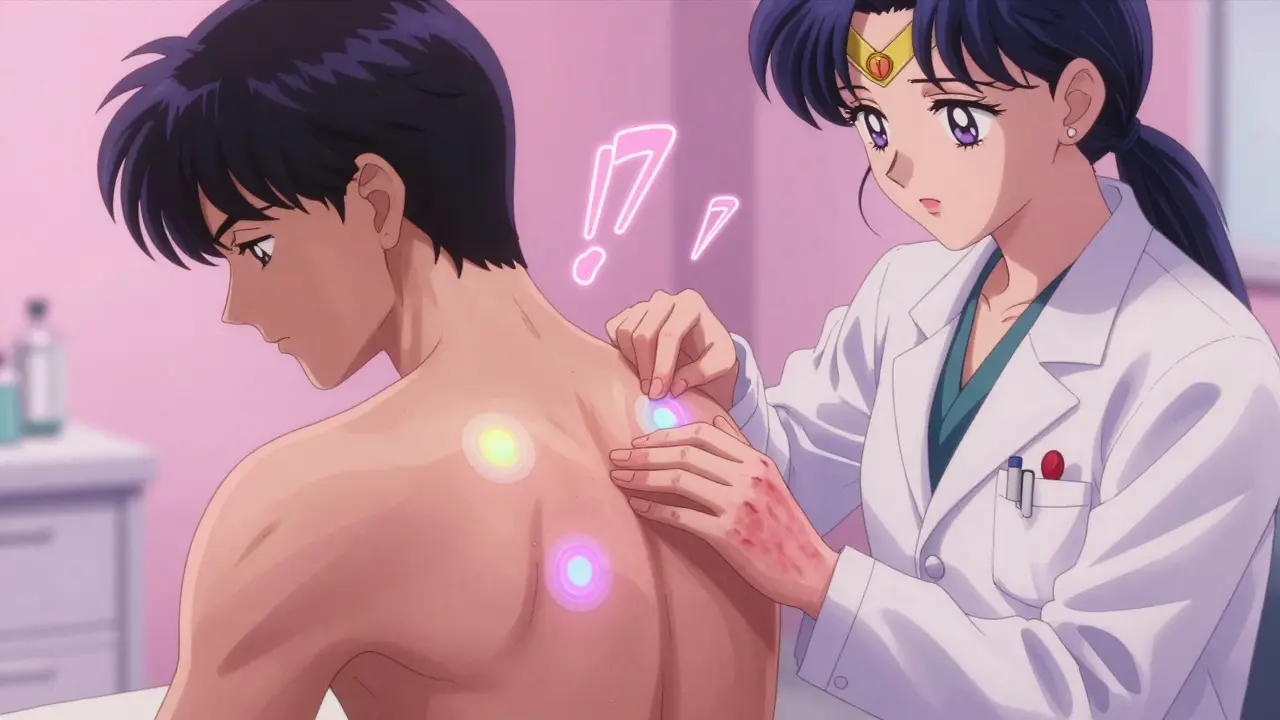
The gold standard is patch testing. This isn’t a quick prick like a needle test. It’s a slow, careful process. Tiny amounts of common allergens-including topical medications-are placed on patches and taped to your back. You leave them on for 48 hours. Then you return for two more readings: one at 72 hours and another at 96 hours. Why? Because allergic reactions take time to show up.When done right, patch testing finds the cause in about 70% of cases. The American Contact Dermatitis Society now uses a standardized panel that includes over 360 potential allergens, including 25+ common topical drugs. Some clinics even test with diluted versions of your own medication, especially if your skin barrier is damaged. Johns Hopkins researchers found this cuts false negatives from 32% down to just 9%.
It’s not perfect. But it’s the only way to know for sure. And it’s worth it. One study showed that 89% of chronic cases resolved completely within four weeks once the allergen was removed.
Treatment: Stop the Trigger, Then Soothe the Skin
The most important step? Stop using the allergen. No cream, no spray, no ointment that contains it. That includes over-the-counter products. Neomycin is in everything-from wound gels to baby wipes. You have to read labels like a detective.Once you’ve stopped the trigger, treatment depends on severity:
- Mild cases: Over-the-counter 1% hydrocortisone cream can help. But if it doesn’t improve in a week, see a doctor. About 40% of patients need prescription treatment within 7 days.
- Moderate cases: Doctors often prescribe mid-potency steroids like triamcinolone 0.1% (Kenalog) or clobetasol 0.05% (Temovate). But avoid these on your face, eyelids, or groin. The skin there is thin and can thin out permanently with prolonged use.
- Face or sensitive areas: Use low-potency steroids like desonide (Desowen) or non-steroid options like pimecrolimus (Elidel) or tacrolimus (Protopic). These work well for allergic dermatitis and don’t cause skin thinning. About 60-70% of patients see improvement, though some feel a burning sensation at first.
- Severe cases (over 20% of body surface): Oral prednisone is needed. A typical dose is 40-60 mg daily for 2-3 weeks, then slowly tapered. Most patients feel better within 12-24 hours.
And here’s something surprising: if you’re allergic to one steroid, you might still tolerate another. Steroids are grouped into six categories (A-F) based on chemical structure. If you react to hydrocortisone (Group A), you can often safely use triamcinolone (Group B) or methylprednisolone (Group D). This knowledge helps avoid unnecessary restrictions.

What About Natural or “Hypoallergenic” Products?
Just because a product says “natural” or “for sensitive skin” doesn’t mean it’s safe. In fact, 30% of allergic reactions come from non-prescription items people don’t even think of as medications-like aloe vera gel, tea tree oil, or lanolin in lotions. A 2023 survey found that nearly half of patients with medication-induced dermatitis had been using a product they didn’t realize contained an allergen.Bring everything you use on your skin to your doctor: creams, lotions, sunscreens, even shampoo. A mobile app from the American Contact Dermatitis Society lets you scan product barcodes and check for allergens. It’s used by over 40% of patch-tested patients.
Long-Term Outlook and New Developments
Once you avoid the trigger, most people recover fully. But it takes time. Healing can take 2-4 weeks. Itching usually eases in 2-3 days after stopping the allergen.There’s good news on the horizon. Researchers are developing molecular tests that could predict allergy risk before you even use a product-potentially preventing 150,000 cases a year. New barrier creams are in clinical trials that reduce allergen penetration by 73%. And in 2023, the FDA required full ingredient lists on all topical prescriptions, which has already cut misdiagnosis rates by 15%.
Meanwhile, dermatologists are shifting toward “steroid-sparing” approaches-especially on the face and folds of skin. Topical calcineurin inhibitors are now first-line for those areas because they avoid the 22% risk of skin thinning from long-term steroid use.
What Should You Do If You Suspect a Reaction?
If you’ve been using a topical medication and your skin is getting worse instead of better:- Stop using the product immediately.
- Don’t switch to another cream without checking ingredients-many contain the same allergens.
- Take a photo of the rash and write down when it started and what you’ve used.
- Ask your doctor for a patch test. Don’t accept “it’s just eczema” as an answer.
- Use a product database app to scan your current skincare routine.
The key is persistence. It might take time, but identifying the allergen is the only way to break the cycle. And once you do, your skin can heal-without relying on the thing that made it sick.
Can you develop an allergy to a topical medication you’ve used for years?
Yes. Allergic contact dermatitis is a delayed immune response that can develop after repeated exposure. You might use a cream for months or years without issue, then suddenly react. This is common with corticosteroids and antibiotics like neomycin.
Is patch testing painful?
No. Patch testing involves taping small patches containing allergens to your back. You don’t feel anything during application. You might feel mild itching if a reaction develops, but it’s not painful. The test is non-invasive and safe.
Can I still use steroid creams if I’m allergic to one?
Maybe. Steroids are grouped by chemical structure. If you’re allergic to hydrocortisone (Group A), you may tolerate triamcinolone (Group B) or methylprednisolone (Group D). Your dermatologist can use this classification to find a safe alternative.
Are over-the-counter creams safer than prescription ones?
No. Many OTC products contain the same allergens as prescription creams-like neomycin, bacitracin, or fragrances. In fact, 30% of allergic reactions come from products people don’t consider medications, including lotions, sunscreens, and baby wipes.
How long does it take for contact dermatitis to clear up?
Once the allergen is removed, itching usually improves within 48-72 hours. Full healing takes 2-4 weeks. If the allergen isn’t identified and avoided, the rash can become chronic and last months.
Liam Crean
February 19, 2026 AT 20:51I never realized how many OTC products have neomycin in them until I started reading labels after my own reaction. I was using a baby wipe for my eczema flare-up-yes, really-and ended up with a full-blown rash on my forearm. Took three doctors and a patch test to figure it out. Now I scan everything with that app they mentioned. It’s wild how something so common can be so sneaky.
Also, the steroid group thing? Game-changer. I was allergic to hydrocortisone, but triamcinolone worked fine. No more guessing games.
Ellen Spiers
February 21, 2026 AT 13:24The assertion that ‘patch testing finds the cause in about 70% of cases’ is statistically misleading without contextualizing the sensitivity and specificity of the panel used. The North American Contact Dermatitis Group’s standardized panel, while comprehensive, still omits several emerging allergens such as methylisothiazolinone derivatives and certain preservative cocktails present in modern formulations. Furthermore, the cited Johns Hopkins data on false-negative reduction must be interrogated for cohort selection bias-patients with compromised skin barriers are not representative of the general population.
Additionally, the claim that ‘89% of chronic cases resolved within four weeks’ lacks longitudinal follow-up data. Recurrence rates post-avoidance are rarely reported, and the assumption of full recovery ignores the phenomenon of epitope spreading in allergic sensitization. This article reads like a marketing brochure for dermatology clinics, not peer-reviewed science.
Hariom Sharma
February 22, 2026 AT 03:30Bro, this is gold. I’ve been using Neosporin since I was a kid-every scrape, every burn. Then one day my hand looked like it had been dipped in lava. Thought I was getting worse. Turns out, I was allergic to the damn thing.
Now I use plain petroleum jelly and let my skin heal. No more mystery rashes. If you’re using any cream and it’s not helping, STOP. Just stop. Read the label. Your skin will thank you.
Caleb Sciannella
February 23, 2026 AT 16:33It is imperative to underscore the clinical significance of the temporal disconnect between the application of topical agents and the onset of dermatological symptoms. The delayed-type hypersensitivity reaction, mediated by CD4+ T lymphocytes, typically manifests 48 to 72 hours post-exposure, which often leads to a misattribution of causality. This phenomenon is particularly insidious in patients with pre-existing inflammatory dermatoses such as atopic dermatitis, wherein the natural fluctuation of disease activity may mask the emergence of an iatrogenic allergic component.
Moreover, the increasing prevalence of polypharmacy in dermatologic regimens-wherein multiple topical agents are concurrently applied-compounds diagnostic complexity. The integration of molecular allergen profiling and component-resolved diagnostics may soon supplant traditional patch testing, offering predictive capacity prior to clinical exposure. This paradigm shift holds substantial promise for personalized dermatologic care and the reduction of iatrogenic morbidity.
Davis teo
February 25, 2026 AT 12:36OMG I just read this and I’m SCREAMING. I used that hydrocortisone cream for 2 years. TWO YEARS. And I thought I was just ‘bad at healing.’ My husband had to drag me to the dermatologist. I cried. I was so mad. I thought I was being weak. Turns out I was being poisoned by a cream I got at CVS.
Now I don’t trust anything with ‘for sensitive skin’ on it. And I told my whole family to stop using Neosporin. My mom still uses it. She’s gonna have a rash next Christmas. I’m not sorry.
Marie Crick
February 26, 2026 AT 03:29This is why people shouldn’t self-treat. You think you know what’s good for you, but you’re just poisoning yourself with drugstore junk. Stop using random creams. Go to a real doctor. Stop being lazy. Your skin isn’t a science experiment.
Tommy Chapman
February 26, 2026 AT 17:30Why are we even letting these foreign-made creams on the shelves? Neomycin? Bacitracin? These are not American ingredients. We got better stuff here. If you’re allergic to your medicine, maybe you’re just not supposed to be using it. Maybe you need to toughen up. I’ve used Neosporin since 1987 and I’ve never had a problem. Maybe it’s just weak skin culture.
Nina Catherine
February 28, 2026 AT 11:55Wait so you’re telling me my aloe vera gel caused my rash?? I’ve been using it for years!! I thought it was healing me 😭
Just got my patch test scheduled. I’m so nervous but also so ready to finally know what’s going on. I’ve been using 5 different creams and none of them helped. I feel dumb but also so relieved this article exists. Thank you!!
Jeremy Williams
March 1, 2026 AT 15:02As a physician practicing in rural America, I’ve seen firsthand how the proliferation of over-the-counter topical agents has complicated dermatologic diagnosis. The average patient presents with a history of 3–5 concurrent topical applications, often including multiple steroid-based creams, antiseptics, and botanicals-all of which may contain cross-reactive allergens. The cultural normalization of ‘quick fixes’ for skin conditions, coupled with limited access to specialist care, has resulted in a silent epidemic of iatrogenic contact dermatitis.
Furthermore, the reliance on anecdotal evidence from online forums-while well-intentioned-often delays definitive diagnosis by 12–18 months. The solution lies not in demonizing OTC products, but in integrating allergen education into primary care workflows. A simple 30-second screening question-‘Have you changed any creams or lotions in the last 3 months?’-could prevent countless unnecessary referrals.
And yes, ‘hypoallergenic’ is a marketing term, not a medical one. Always check the ingredient list. Even if it’s ‘natural.’